Showing posts with label Mario. Show all posts

Wednesday, April 8, 2015

Super Mario Land (1989)

Image shamelessly linked from Museum Of Play.
Just look at all the cool stuff on the front cover - Mario is
obviously in for a big adventure this time around!

It's quite timely that the 2015 edition of Review a Great Game Day is happening as I begin to cover the Game Boy library, especially since I'm trying to get the 5 North American launch titles out of the way in relatively short order.  Not that there's anything inherently wrong with them; far from it.  In general, the launch library was a demonstration of the baseline for what the Game Boy hardware could do.  Ultimately, many subsequent games released for the Game Boy would far and away eclipse the launch titles in terms of scope, size, graphics, sound and gameplay, as we'll discover together through this journey.  As most gamers know by now, however, the technical wizardry is only window dressing.  If the game isn't fun, it doesn't matter how pretty it looks or sounds.  Super Mario Land is a complete package - it looks good for its time, sounds good, and is loads of fun.

One look at that title screen, 
and you know you're in for a good time.

It's no stretch to say that by 1989, as far as home entertainment goes, Nintendo ruled in North America.  Microcomputers were still the rage in Europe, and Japan had a flurry of competition between Nintendo's Famicom console, Hudson's newer PC Engine console, and the still fledgling Sega Megadrive, the successor to the Mark III (Sega Master System).  In the good old US of A, however, Nintendo dominated the market due to good marketing, and also due to some strong-arm licensing tactics that created difficulty with 3rd party publishers, especially if they wanted to develop software for a competing platform, such as the Master System or the new Genesis system.  Between the popularity of the Super Mario Bros. franchise, 2 installments in (3 in Japan, by this time), plus other popular Konami and Capcom properties, the NES was a force to be reckoned with.  It wasn't the most powerful hardware on the market, but with games as good as what we were getting, that didn't matter, because the final product was high-quality and fun.  Nintendo of Japan wanted to replicate that success with the handheld market, which translated into the Game Boy.  Naturally, Nintendo would want to bring their flagship character, and primary mascot, to the new platform.  It had to be a good game, or the franchise's staying power could be jeopardized.  Thankfully, it turned out to be a great game.

Look at all the shiny coins!

Mario, being the nice guy he is, was somehow informed of the goings-on in Sarasaland, a magical place, not unlike the Mushroom Kingdom.  Apparently, a ruthless alien named Tatanga has run amok throughout the 4 realms, and his minions have taken over.  Princess Daisy, who rules over Sarasaland, has been taken captive, and Mario takes it upon himself to rescue her from the evil alien.  He must traverse all 4 realms, defeat Tatanga's minions, and bring peace to the land once again.  Either Mario is a sucker, or he's just the nicest guy in the universe, because he continues to save princesses and people over and over again.
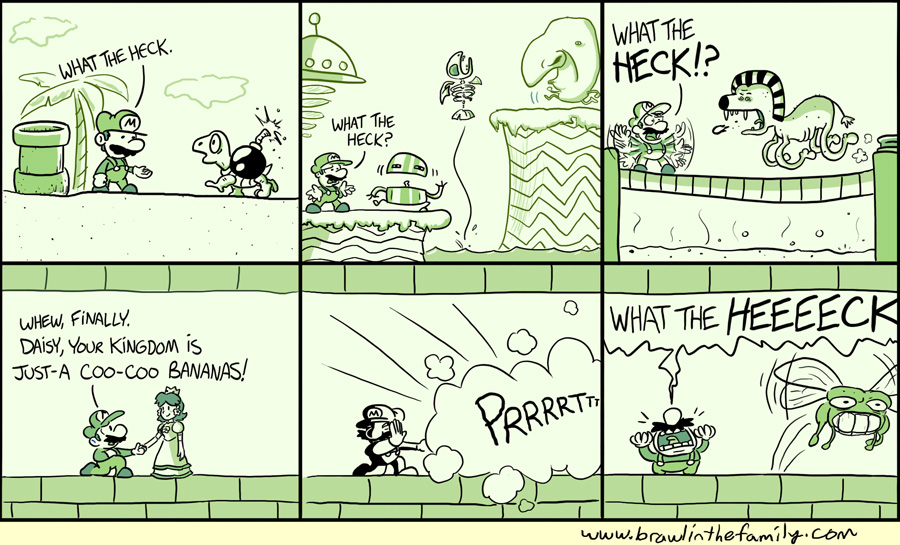

Image shamelessly linked from Brawl In the Family.
This comic perfectly illustrates the double-take most fans might have
done when first playing the game, due to the unfamiliarity of many
elements in the game's world, Sarasaland, much like they did when
they first played Super Mario Bros. 2, with the new "pull" mechanic, as
well as all the new enemies and locations in the game's world.

"I'll take what's behind door #2, Bob."

Thankfully, Mario has a couple tools at his disposal to help him along the way.  Along for the ride is the usual super mushroom & invincibility star, as well as 1-Ups that come in the form of hearts now, instead of mushrooms, most likely due to the lack of color to distinguish them from the super mushrooms.  Also, there are flowers in this game, but they're not "Fire Flowers".  Instead, they give Mario the ability to throw bouncing "superball" power-ups.  Interestingly, these superballs will bounce off any surface at a 45 degree angle, and will keep bouncing for a short time until they leave the screen, or wear out.  A new element here also is that superballs can collect coins, a gameplay mechanic you'll likely use more than once in the game.  Be aware that only 2 of the superballs can appear on the screen at any given time, so if you jump the gun and fire off 2, and neither hit the enemy you're targeting, you'll have to wait to throw more, and possibly dispatch the foe using the standard stomp method.  Also, if you reach the end of the level and can get to the upper door, you'll participate in a mini game where you can score extra lives, or a superball flower power-up.

Cats have 9 lives, but for Mario, the sky's the limit.

Sarasaland has a bevy of new antagonists.  Goombas (Chibibo) and Piranha plants (Pakkun) have apparently populated Sarasaland under new aliases, but Koopa Troopa's (Nokobon) now explode shortly after stomping them.  There are goofy robots, running Easter Island heads, jumping fish carcasses, strange flying insect hybrids that throw arrows at you, jumping stone statues with wings.  The denizens of Sarasaland are bizarre, indeed.  Somewhat surprisingly, there are more enemy types in this Game Boy adventure than there are in either the original Super Mario Bros. or its sequel. 

"I hope this treasure is worth all 'o the extra effort!"

If you've played the original Super Mario Bros. game, you'll be right at home here with the gameplay.  Mario can jump with the A button, walk, run (holding down the B button), throw superballs with the B button, and duck by pressing down on the D-pad.  Jumping up to a block as Super Mario will break bricks and get coins and other items from question blocks.  Mario's movements are quite similar to those of his first side scroll outing, though gone is the inertia that takes place when you let up on the D-pad while moving left or right.  Mario stops almost dead in his tracks when you let go.  Some folks will find this refreshing, because they disliked the inertia.  Others, like myself, found it a tad jarring, though it doesn't take long to get used to.

Spacecraft in a Mario game well before Super Mario Galaxy!

Graphically, the game was fairly impressive for an early game, and certainly the most visually impressive and appealing launch title.  Despite his diminutive stature on screen, Mario is instantly recognizable as the protagonist.  Nintendo chose wisely to use a very minimalist approach to the backgrounds, with a few trees, pyramids, and various other elements in the background, but not overdo it.  It's quite reminiscent of the first NES title, though perhaps a bit more detailed to make up for the lack of color.  Locales are interesting and varied, as the 4 "worlds" within Sarasaland all have a relatively distinctive look, and some variation within each from one stage to the next.  For example, in the first world, the Birabuto Kingdom, you start out in an overworld, much like the original Super Mario Bros., but progress into an area inside a pyramid-like structure later in the world.  In world 2, the Muda Kingdom, you start again in an overworld scenario, but end up in a submarine underwater in a later stage.  Each stage is well laid out, and the graphical detail is enough to make it interesting, but not overdone so as to make it hard to see what's going on.  Animations are well done, despite being quite sparse.  I never noticed as a kid, but most enemies have only 2 or 3 total frames of animation.  Despite that limitation, it still looks and feels like a Mario platformer.

When did Mario games suddenly become shoot-em-ups?

The sound design in the game is also of equal quality.  The music is super catchy, thanks to composer Hirokazu Tanaka.  His score for the game is indelibly stuck in my head, and I've used the Stage 1-1 music as a ringtone, both on my various mobile phones, as well as my office phone, multiple times in the last 10 years.  The songs all have that Mario-esque vibe to them, though they're a bit more expansive.  By that, I mean that some of the songs have a specific, thematic bent to them.  There's a read Egyptian feel to the music from the Easton Kingdom, and a traditional Oriental feel to the music in the Chai Kingdom.  All the music in the game is interesting, and repeated plays will guarantee that one or more tracks will be on repeat in your subconscious.  Sound effects are also well done, with recognizable sounds for jumping, the transition from regular to Super Mario, grabbing the flower, the coin sound, the block hit & break sounds, etc.  New sounds are also done well, with some interesting effects to simulate voice when pelting bosses with superballs, or some of the enemy deaths.  It makes good use of the Game Boy sound hardware for such an early title, and you can tell that the sound design was as much a work of love as the rest of the game.

Speaking of shoot-em-ups, Nintendo takes a page from
the Konami handbook with the Easter Island heads.

The biggest drawback of the game is its relatively short length.  I say that, still being a huge fan of the game, but looking at it objectively, it is awful short.  That's especially true, considering the game's relatively meager difficulty.  As a kid, it didn't take me more than a couple weeks to go from just starting to play to actually beating the game.  Despite that, it's still a lot of fun to play, because Mario is adventuring through an entire new set of worlds that are interesting to traverse and look at.  The difference in inertia for Mario, as mentioned before, is a small issue, but worth mentioning.  Looking back at the entire library of Game Boy titles, most point to the sequel, Super Mario Bros. 2: 6 Golden Coins as the superior game, and from a strictly technical aspect, they're probably right.  However, this game remains my favorite of the 2 because of the sheer fun factor, the variation in the levels, enemies, bosses, the great music, and the fact that the game moves along with no slowdown.  This is a bona fide classic, and a must have for any Game Boy collector or aficionado's library.  Essential.

"Finally, I get to face-a the evil Tatanga!"


"Hey, Princess Daisy, why don't-a you take a ride with
me in-a my brand new space-a-ship, huh? Woohoo!"

Tuesday, March 24, 2015

Donkey Kong (1994)

Image shamelessly linked from the Super Mario Wiki.
When did Pauline become a brunette in a red dress,
instead of a blonde in a pink one? The Mario canon
is a confusing one, indeed.

Donkey Kong, sometimes referred to as Donkey Kong '94, or Game Boy Donkey Kong, is a re-imagining of the original 1981 arcade smash.  I say a re-imagining because, though the game includes the original 4 levels of the arcade game, it also includes an additional 97 (!) levels beyond that, taking place over the course of 9 "areas", comprising of stages in multiples of 4.  It's an ambitious move for Nintendo, considering that it comes over a decade after the original game's release, and a solid 8 years after the incomplete NES port of the game.  Despite the original titles modest graphics and sound, can that successfully translate to the small Game Boy screen?  More importantly, can Nintendo devise that many levels that are worth playing through?  The answer to both is, unsurprisingly, yes.

It is perhaps poignant that I cover Donkey Kong first, considering that the Game Boy's architect, Gunpei Yokoi, produced the original arcade game, supervising a then young Shigeru Miyamoto.  There was no Mario yet, only Jumpman, a relatively generic protagonist with just enough personality to make him interesting.  The tried and true formula of "man saves damsel in distress" hadn't been overtly done in video game form yet, in part because, until Donkey Kong came around, most game characters were space ships, save for Pac-Man himself.  So while the damsel in distress trope had been widely used in film and television throughout the 20th century, video games were still a burgeoning market, teeming with all manner of untapped potential.  To say that Nintendo invented the "platformer" genre with Donkey Kong is to do them a disservice.  Nintendo revolutionized the gaming industry with the game, and the innovative approach of a semi-realistic human protagonist.


We're squaring off with this handsome fella!

The game starts out simply enough, reprising the original 4 stages that made up the arcade game.  After that, however, rather than reuniting with Pauline, Mario (now obviously the protagonist in this reboot) watches as Donkey Kong scoops her up in his hairy arms and carries her off to the Big City, the first set of levels designed specifically for this title.  Things get interesting very quickly, as Mario is given a limited set of moves and abilities from which to pull.  Mario has a new jumping mechanic he can employ, and can duck to miss some enemies or dangerous obstacles, as well as using a hammer (as in the original), climbing ladders, jumping over barrels and enemies, and so on.  A fall from too great a high results in Mario's death, and touching an enemy results in either temporary paralysis, or instant death, depending on the foe.  During boss battles with Donkey Kong himself, don't get close enough to let him get his hands on you, or Mario will die immediately.


This looks familiar...

The basic goal is to pull levers, jump on platforms, run, and climb to reach a key, found in each level, and then pick up that key Super Mario Bros. 2-style, and carry it back to the locked door to open it and progress to the next level.  Do this 3 times, and you'll face off with Donkey Kong himself in a sort of boss battle.  Some of the boss battles play out like stages from the arcade original, where you simply have to make it to the top without getting hit by flying barrels, enemies, or other obstacles.  Other boss battles give you the opportunity to confront the giant ape by picking up stationary barrels he throws down, and then throwing them at him.  After 3 hits, Donkey Kong retreats with Pauline to the next stage.  These boss encounters are varied and enjoyable, because the tactics change from one encounter to the next, and you won't be using the same strategies throughout the game.


The little "cut scenes" between areas are very cute,
and help keep things light.

Much of the innate complexity of this game revolves around the balance between 2 levels of time management, semi-precise platforming and jump mechanics, and figuring out in what order to do certain things or take certain actions.  For example, you may be in a level that has multiple levers to pull that do things like opening the gate where the key to exit the level exists.  However, pulling that lever activates a hidden platform which blocks the key from the easiest path to reach it.  You may need to find another lever to pull which will open a path to reach the key from another vantage point.  You're always working against the clock, so that's a time management scenario, but then, sometimes you need to employ temporary items like a ladder or floor that can be activated by touching the icon floating on the screen.  Once activated, those only stay on screen for a limited time, so that's time management scenario #2 - figuring out how and where to use those, and do so before their time limit is up.  You'll occasionally find that the time required to complete a task, and the time allotted by the temporary floor/spring/ladder/etc. is nearly equal, so the pressure is on to find the most efficient and expedient way to accomplish a task.

If you're like me, you'll also find that less-than-perfect jumps will result in a lot of untimely death for Mario.  You may burn 10 lives or more on a single stage, before you figure out what sequence of events you need to trigger in order to get the key and make your way to the exit door with key in hands.  Did I mention the key is on a time-limit as well?  Yes, if you drop the key for any reason, it only stays accessible for a short time as well, and then reverts back to where you obtained it from.  If you fall from a platform, and fall too far, you drop the key as well.  Sometimes you'll fall far enough to drop the key and go paralyzed, but not enough to where Mario expires, so you might have enough time to get the key before it disappears, though depending on the stage's layout, you may or may not be able to reach the area you need to.  It's a constant shuffle between managing your time and finding the path that will lead you to the exit door with the key.  Because you cannot climb while holding the key, and because the extended jump mechanics don't work with the key either, you'll be finding creative ways to get from one point to another.


Every four stages and you'll face off against Donkey Kong.

There's a deceptive simplicity in the level design, especially early on.  Some levels can be accomplished in a couple ways, based on what obstacles are in the way.  Most, however, require a fairly concise and specific set of tasks to complete in order to obtain the key, and open the way to reach the exit.  Once you expend a few lives on a given level, you'll start to see the pitfalls and paths form, and some manner of logic to the design will start to appear.  I found myself stumped a couple times, and had to consult a walk-through, though out of nearly 100 levels, that only happened 2 or 3 times total.  The majority of the levels will slowly reveal their solution to you as you play through it and think critically about Mario's abilities, limitations, and especially what you can and cannot do once  you have the key.  You'll find that some levels seem easy at first, because obtaining the key is a snap.  The challenge often presents in getting the key to the exit, rather than obtaining the key itself, and vice versa.  And then sometimes, both things seem nigh-impossible.

Graphically, the game is solid, with little bits of animation here and there to highlight the action.  When Mario falls and gets paralyzed, you'll often see Mario look dazed and confused, or if he gets squished by something, he'll end up flat and float to the ground like a piece of paper.  The attention to detail, given the platform's limited capabilities, is impressive.  Another thing I noticed is that, while some levels have busy backgrounds or areas, most of the stages have a minimalist approach, where the bulk of the graphics are in the foreground, so as to allow the player to concentrate on the puzzle solving aspects.  This was a smart design decision, because the graphics then enhance the experience, rather than trying to do too much and distract from the player's ability to learn the levels.  Donkey Kong is well animated, and most enemies and obstacles have some subtle animation that works well.  Some of the animation sequences between areas and stages also serve to demonstrate abilities that Mario might have to use in the coming stages, which is a nice touch.


"Stop! Hammer time!"

The sound design in the game deserves some recognition as well.  While many of the background tunes aren't overly memorable, they are fitting to their respective levels, and mostly unobtrusive.  The sound effects, on the other hand, are where this game often shines.  The little Game Boy speaker and sound hardware isn't overly capable, but with the right programmer, can do fun things.  The "voice" of Pauline yelling "Help!" is a nice touch, though after hearing that yell 15 times in a row on the same level can add to the frustration.  Donkey Kong's grunts and growls are nicely approximated on the hardware as well, in similar fashion to the laughs and other voice work in Mike Tyson's Punch Out!! on the NES.  The rest of the sound effects all make sense, and are a nice addition to the game.  I appreciate the nod to the original with the level intro music, and the tune that plays when selecting a stage on the map screen, as well as the sound that plays when you successfully jump over an enemy or obstacle.

I found the difficulty curve to be rather manageable, until toward the end of the 7th area.  Particularly, I struggled a lot with Stage 7-9, and then again with 8-9.  Thankfully, some of the more difficult levels contain 1Up icons to collect, so you can have a few tries to figure them out.  There are also 3 special items you can collect during each level: a hat, an umbrella, and a handbag.  Collect all 3, and you'll get to play a mini game where you can win extra lives.  You'll need them, because some of the levels will require multiple deaths and attempts before you know just what to do to complete them.  I found that many stages could be completed on the first try with little effort, because the way to get the key to the exit was obvious.  Others are real head-scratchers, and make you work your brain to determine how to approach them.  I will say specifically, patience is a virtue with this game.  Don't go in expecting to barrel through (pun intended) a level with your highly refined platforming skills, because it takes more than a mastery of jump mechanics to get the job done.  Take your time, watch the activity in a level to see how and where enemies appear, where moving platforms go, how long it takes for certain things to happen, and you'll be that much farther ahead in being able to plan your next move.


"Slow ride, take it easy."

All in all, the inclusion of the original levels, nods to the original (and Donkey Kong Jr.) throughout the game, and all the level design ingenuity make for a really fun and rewarding experience.  You might feel like launching your Game Boy into the stratosphere a few times after you've lost 12 lives in a row, but keep pressing on and don't let the frustration overtake you; you'll find that once you figure out what is stumping you, there's an overwhelming sense of victory and accomplishment that is the big payoff for taking the time to figure those hard stages out.  Keep in mind, too, that this game has a battery backup to allow you to keep up to 3 consecutive games going at a time.  Burn through all your lives trying to figure out an area?  Just power your Game Boy off and back on to load the save and keep trying.  Add to that the Super Game Boy compatibility, and you have a pretty complete package that should please both fans of the original arcade game, and puzzle platformer fans alike.  I would highly recommend this title to anyone with even a passing interest in Mario, Donkey Kong, or platforming games in general.  Something this well designed and executed should be in any Game Boy collector's library.  Highly recommended!