Showing posts with label Tetris. Show all posts

Friday, April 3, 2015

Tetris (1989)

Image shamelessly linked from GameFAQs.
This was a game even your grandmother could love.

Every video game console has at least one game that defines it.  One title that, above any other, people associate with it.  For modern consoles, it's often a launch title that soars above the rest in quality, or a later game that is exclusive to that system.  Usually, it's a great game that is universally hailed as something special.  For early consoles, that game often happened to be the pack-in title, i.e. the game that came with the system when you bought it.  In the case of the Game Boy, that game was Tetris.

The thing about Tetris, however, is that it's not just a quality pack-in title.  It was a mission statement.  It was the perfect representation of the hardware's untapped potential, and the kind of game that could sell a Game Boy to even the most ardent anti-video game folks out there.  Why, you ask?  The answer is quite simple; Tetris is fun for all ages.  Read that statement again, because I don't say it lightly.  Your parents, grandparents, aunts, and uncles may have no interest in blowing up aliens, stomping on walking mushrooms, or other such things, but a game with jigsaw-like puzzle pieces that move, and you have to put them in order to eliminate them from the screen?  Most anyone can get on board with that.  Large numbers of people did.


It's not a stretch to say tens of millions of people
worldwide have seen this title screen many times.

Unless you were alive and invested in video games in the mid-late 1980's, it's hard to truly explain the "mania" surrounding Tetris.  It was a craze, and nearly everyone was affected by it.  The storied battle between Tengen (Atari) and Nintendo over the rights to Tetris on the Nintendo Entertainment System is better documented elsewhere, but suffice to say, history proves that Nintendo won the battle, at least from a legal standpoint.  The game, upon a release on the NES and in the arcades, became a huge hit, and Nintendo, having scored the rights to the game on the NES, scored a major coup on the home console front.  That coup was further cemented by the inclusion of Tetris as the pack-in game for the original Game Boy.  Unfortunately, I haven't been able to get good figures for the sales of the Game Boy with the included Tetris pack-in, because sales of the Game Boy Pocket and Color models are lumped in with the original "white brick" version in all official sales statements, but sales of Tetris itself were upwards of 35 million units.  So of the 118.69 million "Game Boy family" systems sold worldwide from 1989 to 2003, we can link over 1/4 of those sales, in some measure, to the popularity of Tetris.

Playing this game again the last few days in preparation for this write-up, it struck me just how much I enjoyed it.  I recalled dedicating hours mastering the 4-line technique, and feeling a huge sense of victory any time I topped 100,000 points.  As a youth, I worked my way up to being able to start on level 7 or 8, and maximizing my scoring potential.  Having not played Tetris seriously in years, I'm not at that level any longer, but I was surprised that, after a couple practice runs, I was starting at level 5 or 6 and having some success in getting scores upwards of 60,000 or 80,000 points, and toppling the 100,000 mark a few times.  As they say, it's just like riding a bicycle; you never forget how, so just get on and ride.


Like many good arcade or early console games, this screenshot,
taken from the game's "attract mode", demonstrates subtly
how to play the game. A brilliant way to introduce the game
mechanics, and something that is lost in today's world of
overly complex games and 30-minute introductory tutorials.

I'll attempt to succinctly describe the game play.  You control a single, slowly falling geometric shape called a "Tetronimo", and can move it left or right, rotate it to the right or left, and press down on the d-pad to drop the piece to the bottom of the playing field, or atop another piece.  Each of these Tetronimo pieces is made up of 4 smaller squares, and pieces range from a large square to a long/tall line, to pieces where the squares are more "bent" in shape.  The grid you play in is 10 squares wide, and nearly 20 squares high.  As Tetronimo pieces fall, you place them on the play field in any order you wish, with the goal being to create a single, contiguous horizon line made of of Tetronimo pieces.  If you can manage to create a 4-line sequence at one time, using the 4-square tall "line" block, you score a big point bonus.  This 4-line clear, called a "Tetris", is the key to getting a high score in the game, and is also the linchpin to the game's deceptive simplicity.  Each time you complete 10 lines, the game's level increases, and the pieces fall faster.  Each time the level increases, the score multiplier for clearing single lines and "Tetris" clears goes up.  Thus, if you start the game at a higher level to begin with, you start with that level's speed, but also its score multiplier until clearing enough lines to go to the next level up from where you started.


"Rocket man, burning out his fuse up here alone."

Graphically, the game is not, by itself, impressive.  Compare it to the graphics on the NES, and the Game Boy's "4 shades of green" palette didn't impress much, and the sprites themselves were comparable, though obviously scaled back.  Context is important, however, and compare the graphics to what we had become used to in "portable gaming" with Nintendo Game & Watch devices, or the Tiger series of dedicated LCD handhelds, and it was a technical wonder.  Pieces fell and actually animated if you rotated them or fell smoothly when used the d-pad to drop them down to the bottom of the play field.  In addition, the minor animations of Mario and Luigi in 2-player mode, or the taking off of the rocket (if you scored 100,000 points or more in a single play), were something that, up to that point, hadn't been possible in a hand-held gaming device.  The graphics are largely utilitarian, but looking back, they're perfect for what the game is.

The game's sound and music is iconic, so it's hard to talk about it without talking about the game's music tracks.  We all know that "Type-A" sounds like a Russian melody, and that's because it was apparently based upon a Russian folk song.  "Type-C" is based on a piece by Johann Sebastian Bach, which gives it that classical sound.  "Type-B", however, is a wholly original tune, and composer Hirokazu Tanaka managed to also channel that Russian folk vibe to great effect.  Add the bouncy title screen theme, the high score music, and the triumphant music that plays as the rocket launches, and despite its diminutive size, the score is as well composed as one could hope for.  Sounds are also iconic, with the funny block rotation sound, the nice "slap" sound when you drop a piece to the bottom, the subtle single-line clear noise, and the not-so-subtle "Tetris" clear noise, as well as the "I'm dead!" sound that plays when you get a Game Over by filling up the play field.  They're not the best sounds you can produce on the hardware, but for an early title, they're still impressive.


If you're a Tetris perfectionist like me, you'll see this screen
a lot as you throw game after game, searching for that
perfect play through where you can execute Tetris after Tetris.

As I mentioned earlier, the ability to manage your pieces on the play field and line them up to achieve a "Tetris" is truly the technique that needs to be mastered to get the most out of the game.  Based on the pieces that fall, I generally try and choose either the right or left side of the board to leave open, stack up pieces to make a complete, 4-line (or higher) group, and leave the space for the 4-square "line" piece to complete that "Tetris" and score big points.  As pieces fall, and you place them, you have to be cognizant of all 7 pieces available, because you might get 3 big squares in a row, or the "L" and "J" pieces, and have nowhere to put them.  This puzzle piece management is of the utmost importance; otherwise, you'll find yourself expending available lines to clear away ill-placed pieces, rather than making "Tetris" blocks.  To increase the challenge, you can press the Select button during play to turn off the preview of what the next piece will be, which removes your ability to plan ahead by a move.


Starting at a higher level means you can rack up points
faster, and begin to achieve scores upwards of 100,000.

It seems surreal to talk about Tetris on the Game Boy, more than 25 years after its release.  It's difficult to pinpoint what it is about the game that makes it so addictive.  I picked it up a couple days ago, intending to play a round or two, and before I knew it, I had burned over 2 hours playing, without even realizing it.  That's much of what the game has going for it - that deceptive simplicity and addictive game play.  That addictive quality is only part of the game's appeal, and hopefully I've illustrated that above.  Make no mistake - if you own an original Game Boy, Game Boy Pocket, or even a newer Game Boy Color or Advance, you owe it to yourself to play the original Tetris release, because it's just one of those games every gamer should experience.  Essential.

Tuesday, March 24, 2015

Introduction to the Game Boy Guru


My name is Josh, and I've been playing video games, in some form, since I was 5 years old.  I first experienced the thrill of video games at the ripe young age of 5, at a family get together.  My uncle brought his Atari 2600 console, and between Pac-Man, Combat, Battlezone, and a handful of other titles, I was completely smitten with the idea of controlling some small, multi-pixel object on the screen.  Every time we would get together with family, I hoped one of my uncles would bring their Atari 2600.  Every time I'd visit friends, I would beg them to play video games.  And eventually, I would own my own gaming platform, but more on that later.

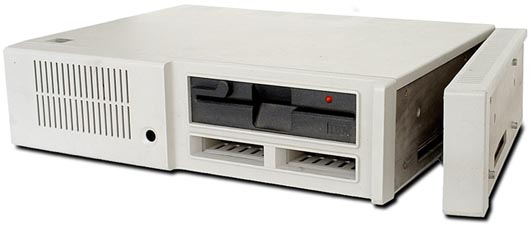
After having been exposed to the Atari 2600 through family members, and then computer gaming through another uncle, my parents bought a family computer.  Mostly, my dad wanted to be able to do productivity stuff with it, but as much time as I could spend on it, I did, playing various shareware games and games designed for the system.  And while we were late to the game, owning the IBM PCjr well after its marketability had all but dried up, that little machine gave me countless hours of joy.  I had adventures with King's Quest, played hoops with One on One Basketball, destroyed property as a Paperboy, and spent hours exploring space and discovering new life forms with Starflight.  Until I started buying games that didn't really work on the PCjr, due to the limitations of RAM (and no hard drive), that computer was the perfect outlet for my early gaming curiosity.


Image shamelessly linked from Old Computers.  Our PCjr had multiple "sidecar"
upgrades to boost it from the stock 128KB to a smoking 640KB of RAM!


My parents wouldn't buy me a dedicated games console, in part, because they said I would monopolize the TV.  They were right, I absolutely would have.  I did have a short stint with my uncle's 2600 when he let me borrow it during part of a summer.  Sadly, the somewhat broken joysticks led me to fits of young gamer rage, which prompted my mom to pack it up and send it back to him.  Once again, I was relegated to just my PCjr, and various friends' consoles, to get my gaming fix.  Thankfully, my next door neighbor had a 2600, NES, and even an original Magnavox Odyssey, and was happy to have me come by any time to play games with him.

There was light at the end of the tunnel, however.  Though my parents wouldn't allow me to own a home console, with only 1 TV set in the house, they did say I could buy a Game Boy, provided I bought it with my own money.  I didn't get that much in allowance money, but I dutifully saved my cash, rather than spending it on G.I. Joe figures, and saved up until my 13th birthday, April 1990.  I bought the Game Boy, complete with Tetris cartridge, and my parents bought me Castlevania: The Adventure as my birthday gift.  It was a glorious birthday, potentially one of the best ever.


Image shamelessly linked from Wikipedia.  This game
was an integral part of my early Game Boy experience.
It was an impressive use of the modest Game Boy hardware.

What followed over the next 2 years was pure childhood gaming bliss.  I bought over a dozen classic Game Boy games: Super Mario Land and its sequel, Alleyway, F-1 Race, Teenage Mutant Ninja Turtles: Fall of the Foot Clan, Kid Icarus: Of Myths and Monsters, Gargoyle's Quest, Final Fantasy Legend, Duck Tales, Dr. Mario, and several others.  I poured a lot of time into my Game Boy, and every time my family went to visit my grandparents or other relatives, I had my trusty Game Boy with me.  When I stayed overnight with friends, we each had our Game Boys with link cables, ready to duke it out in Tetris, Dr. Mario, or whatever other 2-player extravaganza we both had.  I also spent countless hours in my bedroom, fighting and clawing to reach the end of Castlevania and Gargoyle's Quest, and a lot of time perfecting my 4-row technique in Tetris.  It was a magical time.

Sadly, that time came to an end in 1992, when I decided that I absolutely had to have a Sega Genesis.  My parents were buying a new TV, so that opened up the possibility that my younger brother and I could buy their old TV, pool our money together and buy a Genesis, so we could experience the awesome power of the system.  I had already played Last Battle, Golden Axe, and the awe-inspiring Sonic the Hedgehog at a classmate's house, and I knew that was what I wanted.  I still didn't have that much money, however, so I ended up selling my Game Boy and all my games to pay for the Genesis.  I don't regret buying, owning, or playing the Genesis, because it's still one of my favorite systems, and I have a ton of great memories of that.  I just wish, in hindsight, that I hadn't let go of my entire collection of complete-in-box Game Boy titles, especially F-1 Race, because I had the 4-player adapter with it.


Image shamelessly linked from GameTrog.
This Genesis model is the one I sold my
Game Boy to obtain.  I still have the system and
box and still use them today.


Thankfully, I recognized my egregious error 2 years later, and when my best friend from school decided to sell his Game Boy, I bought it from him without a moment's hesitation.  Granted, I didn't get back the boxes and manuals, but I did reacquire some favorites like Tetris, the original Super Mario Land, and Alleyway.  I soon purchased Dr. Mario and Duck Tales again, and was reliving the fun of owning a portable system once again.  I snagged Super Mario Land 2: The Six Golden Coins (still have that complete-in-box!), and loved it, as well as a handful of other games, to eventually get back nearly all the titles I enjoyed just a few short years earlier.  By the time I graduated high school, however, I wasn't gaming much, in part because all my money was going toward dating my girlfriend.

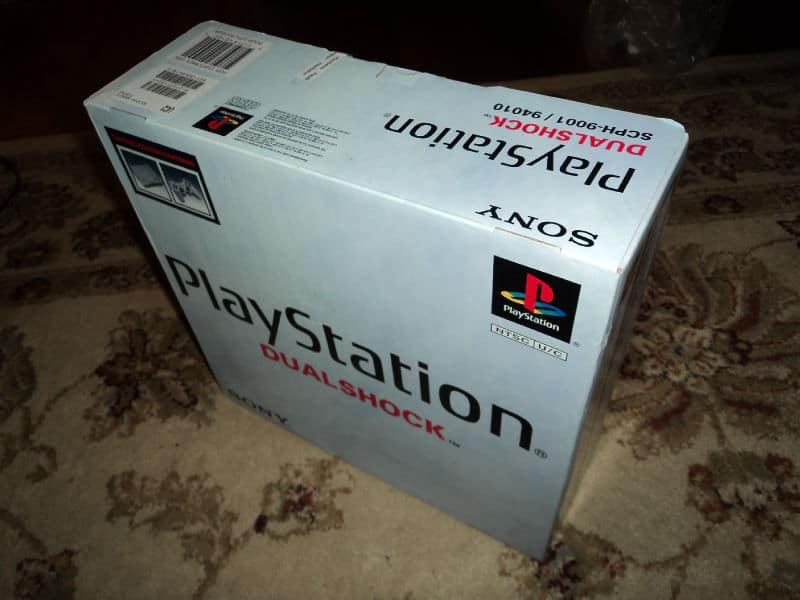
I rediscovered gaming again in 1998 when my wife and I took a trip to another uncle's house for a big family get together weekend, and my younger cousin had his PlayStation there.  We spent the better part of that weekend pouring over Tekken 2, and my wife decided at that point that we needed a PlayStation.  We bought one, got Tekken 2 and Tekken 3, and I also picked up a couple shmups and a copy of Final Fantasy VII.  Once again, I immersed myself in gaming, and though my Game Boy laid largely dormant during that period, I was still cultivating my love for gaming, and the memories of that earlier time were still part of what propelled me to continue to invest in games.  I spent a lot of time with that system, and it's still one of my favorites to this day.


Image shamelessly linked from GameSniped.
This DualShock PlayStation model is what I have, and
still have, complete in box.  I sunk a LOT of hours
into a whole cadre of games on this great system.

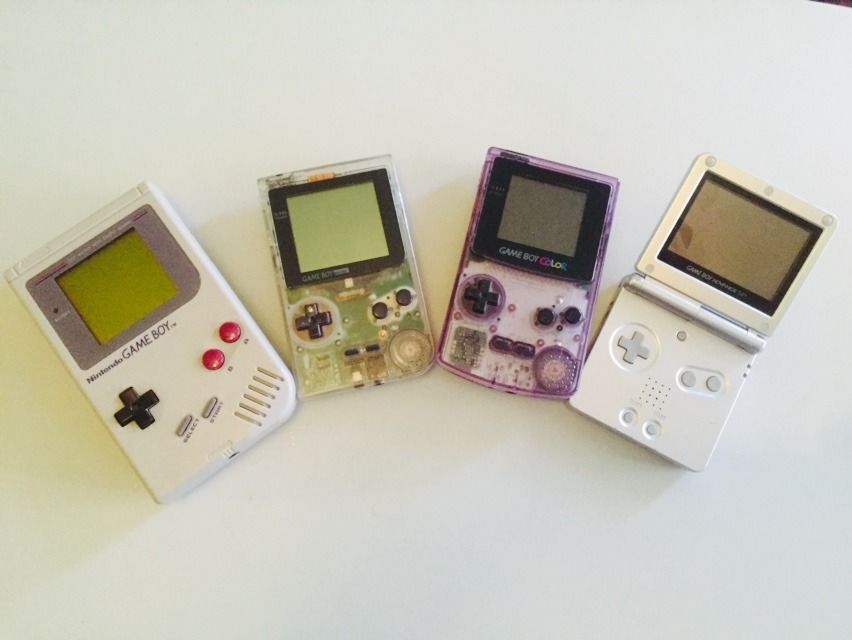
In 2000, I got the itch to get back into portable gaming again, so I picked up an Atomic Purple model of the Game Boy Color.  I could go back and play my existing Game Boy library, and then also some new games I picked up, like Bionic Commando Elite Forces, Project S-11, R-Type DX, Frogger, and even the goofy game The Smurfs' Nightmare.  Once again, I immersed myself in portable gaming, taking the unit with me on trips and to various places when I had the chance.  The screen was better, it only used 2 batteries instead of 4, was more truly portable, and I could plug in one of those ingenious "snake light" peripherals to give light to the screen without a giant, bulky attachment.  Suddenly, my original Game Boy library came alive again, some titles with a reasonable amount of color, and on a much improved display.

I missed out on the Game Boy Advance immediately, because I was concentrating on mostly console and PC gaming throughout much of the mid-2000's.  I didn't pick up a GBA until years later, sometime in 2008 or 2009, when I found a GBA SP very reasonably priced at a used game store.  Within a short period of time, once again, I found myself enjoying old Game Boy games, picking up more original Game Boy and Game Boy Color games I hadn't owned before, and also buying new Game Boy Advance games that had come out years before.  The advent of the backlit display was a huge bonus, and the GBA SP is still my handheld of choice for playing any of my Game Boy library.  My portable gaming life is now split between my GBA SP (and library of Game Boy family of games), and my Sony PSP, which my wife bought me for Christmas in 2005.  I occasionally cross over, playing some GB, GBC, or GBA titles on the PSP (via custom firmware and emulation, of course), in part, due to save states, and additional color options, but sometimes strictly out of convenience.


Image shamelessly linked from Wikimedia.
The stunning silver Game Boy Advance is my weapon
of choice when it comes to playing GB games on the go!

So now we come to the genesis (sorry, pun intended) of this project!  There are a number of folks who have endeavored to do full system reviews, which are game-by-game analysis of every title for the respective console(s) they've chosen.  You have Nintendo Legend, and Dylan Cornelius' Questicle project to review every North American NES title, and his subsequent descent into all things Sega with his Sega Does website and podcast.  You also have HuCard Heaven, for TurboGrafx and PC Engine games, and Sega Galactico, aka The Sega Legend, working his way through the Sega Genesis library.  Tom Hall, of the Breaking Bits Podcast, calls himself the N64 Connoisseur, and is attempting to review every North American N64 release. Not every system has a "Legend" working on the game library, but it's becoming more prevalent.  In the Game Boy space, there's GameBoyle, a fantastic YouTube series and Twitter account of a great resource for all things Game Boy.  There's also Game Boy World, a great resource of GB game reviews and information.

So why does the world need a Game Boy Guru?  I'm not sure it does, but as my conversation with Dylan Cornelius went (great dude, go follow him on Twitter right now!), the more people exploring the entire game libraries of each console, the better.  The more people that are uncovering the lesser known titles, milling through the shovelware, and truly highlighting the best games of a platform, the better off the retro gaming community will be.  My opinion may be just one in a sea of opinions, but I want to express it just the same.  This will be an outlet for me, but also a learning experience, since the vast majority of the Game Boy library remains undiscovered by me.  As much as I've enjoyed my Game Boy systems over the years, I'd love to play through a lot of the library.  I've been actively buying Game Boy, Game Boy Color, and Game Boy Advance games when I find them inexpensively, and have built a small, respectable library that will be a great place for me to start.

"It's dangerous to go alone, take one of these!"

I hope to build a near-complete collection of North American Game Boy releases, as well as eventually getting close to that with both the GB Color and GB Advance.  I will cover Japanese and European games if and when I can, based on when I can acquire them.  If the site gets good feedback and people are asking for content faster than I can acquire games, I may look into Patreon or some way folks can help me continue to acquire games for review.  I may also look into a YouTube channel, though my existing channel has been quite neglected of late.  Either way, I want to bring you my thoughts on the Game Boy family of handhelds, and I felt like now was the right time to start doing that.  Game on!