Showing posts with label Nintendo. Show all posts

Tuesday, August 1, 2017

Nemesis (1990)

Box art shamelessly stolen from GameFAQS.
Shoot-em-up box art was always pretty "metal" during the 1980's
and early 90's, but even this cool art pales in comparison to the
Japanese box, which parallels the original Gradius arcade flyers.

Scrolling shoot-em-up games are one of my favorite classic game genres.  I already established this, in my review of Solar Striker, but because it's been a while since I posted that review, I wanted to make it abundantly clear.  I'm not always very good at them, but I have fun trying.  Though I occasionally go into fits of gamer rage because I die at the exact same spot 12 times in a row, it's the idea of inching your way through a furious gauntlet of incoming enemy waves, laser fire, and shrapnel, that fascinates me to this day.  One of the shmups that defined the genre was Konami's arcade classic, Gradius, referred to as Nemesis, outside of Japan.


I'm not entirely sure what's happening here.  Is the Moia head looking at
the dinosaur bones, satisfied from a meal, or wishing they still had meat
on them, so it could partake? Either way, it looks quite menacing in pixels.

Gradius was a break-through in a number of ways.  It took the basic, side-scrolling shooter formula that Konami had previously pioneered with Scramble, and instead of the constant struggle for fuel, replaced that with an intricate upgrade system.  If also made things far more detailed and interesting, with markedly improved graphics, catchy and memorable music, and an interesting concept of "shoot the core" with the bosses.  This helped solidify the idea of end bosses having weak points, so that you couldn't just shoot them anywhere to deal damage.  All of these elements were instrumental to the genre as it developed, and became mainstays, not only in the later Gradius games, but in shooter games on the whole.


The ACTUAL title screen looks far less menacing. But it still has the
awesome logo design, which remains a staple throughout the series.

Nemesis, Konami's first shmup entry into the Game Boy library, by way of their Ultra Games imprint, is a fine shooter that, while borrowing its namesake from the worldwide arcade and Japanese MSX releases, doesn't quite match the arcade game in terms of design.  Nemesis on the Game Boy takes elements of the original arcade game's design, and implements them here, but there's original content as well, making for a bit of a mashup, of sorts.  Rather than a straight arcade conversion, you get something that feels familiar, but with enough original material added so it also feels fresh and new.  And compared to the previously mentioned Game Boy shmup outing, Nemesis is the Cadillac to Solar Striker's family station wagon.


Like Konami's other early Game Boy entries, they wisely choose to
include a level select, as well as  giving players the option to change
the button config, toggle auto-fire, choose the difficulty level, and
grant themselves extra lives.  This makes the game much more
suited for quick sessions on the handheld Game Boy hardware.

For the uninitiated, the major draw of the series is the power-up system.  As you shoot down enemies, some of them will drop special icons that you pick up.  The first one you obtain will light up the first entry on a small bar at the bottom of the screen, allowing you to increase the speed of your ship.  If you elect to wait until you've collected more icons, each subsequent pickup will shift the selection on the bar over by 1 space, until you've reached the end, then it wraps back around.  In slot 2, you can add missiles to your ship's arsenal.  Slot 3 yields the "Double Shot", which upgrades your ship to not only shoot forward, but also a 2nd shot will fire upwards at a 45 degree angle.  Slot 4 gives you a power laser shot that fires directly ahead.  In slot 5, there's what's called an "Option" - this creates a small entity that follows your ship around and doubles your firepower.  In most Gradius games, you can add up to 3 or 4 of them.  Due to the obvious limitations of the Game Boy hardware, you can only add 2 in this game.  In the 6th and final slot, you can add a force field to the front of your ship, which is capable of absorbing some damage so your craft doesn't explode from contact with a single volley.  You can power up your speed multiple times, and your missiles twice, and in any order you like, so it's obvious to see that the way you approach the game can be entirely your own, and you can really experiment with the weapon load-out.


If you can get good enough to survive the initial onslaught of enemies,
it's pretty easy to get fully powered up during the first level of the game.

All this weaponry, and all these options (pun intended) available to you, don't necessarily mean you're going to walk through this game, however.  Nemesis is quite the challenge, for a handheld title, and if you're going to beat the 5 main stages, you'll need to hone your skills, sharpen your reflexes, and memorize some enemy patterns, placements, and attack vectors, in order to survive.  You'll also need to make sure you power up your ship as quickly as possible, as the waves of enemies are generally more than your tiny craft can handle with its default pea shooter and slow speed.  Thankfully, in addition to the power-up icons, you'll occasionally be granted a smart bomb icon instead, which will destroy all low-level enemies on screen at once, along with any bullets.  Be careful not to run into any scenery, however; the ground and other obstacles aren't just backgrounds - some of them are in the foreground with your ship and will destroy you in a single hit, even when you're equipped with the shield.


Like me, you'll probably be seeing this screen a lot at first.

A common strategy that I like to use for powering up goes as follows.  First, increase the speed of your ship by 1, so you can more easily dodge enemies and incoming fire, as well as more quickly grab additional power-up icons.  Second, activate your missiles, so you have additional fire to help ward off enemies.  Third, get yourself an Option, so you can double that firepower.  Fourth, grab the second option available to you.  Fifth is a toss-up between powering up your forward fire with the laser, activating the double shot, or adding the force field.  I usually opt for the laser or double shot, to more easily mow down enemies, then go for the shield later.  Lastly, once you're fully powered up, keep collecting power-up icons for points, but keep track of where your power-up bar is at.  If you can stop collecting after cycling through them once or twice, and leave it on the sixth entry, you can easily activate the force field again if you take too many hits and are left defenseless.


This is one of the more formidable enemies. It takes a lot of damage,
and the 3 pods it shoots out are impervious, so you have to dodge them.

Graphically, Nemesis is an impressive game.  Konami had excellent command of the Game Boy hardware early on, and after several years of programming for Nintendo's Famicom and NES hardware, were naturally adept at bringing this kind of 8-bit action to the small screen.  Some developers had a hard time adjusting for the scale of the small screen, but Konami's early efforts always seemed to strike that nice balance between good graphics, and proper scale and playability.  Your ship is large enough to see some detail, and look nice, but small enough so that it doesn't feel claustrophobic amongst the enemies, incoming fire, and stage layout and obstacles.  The enemies are mostly recognizable from other Gradius games, outside of a handful of original creations for this title, and are all well rendered.  Backgrounds are minimal, which works well, because it cuts down on the motion blur on the hardware.  Instead, most of the areas are given excellent graphics to show off the terrain and obstacles, and they all look really nice.  Animation is limited, but there are a couple spots that have what appears to be parallax scrolling, which was quite a feat on the system.


When you destroy a boss, it disappears in this really cool, satisfying "warp"
effect, where the sprite splits off into different lines, and the images diverge
in different directions. It's hard to explain, but it looks great on the hardware.

In the audio department, Nemesis is the usual Konami par excellence.  Konami really knew how to get the most from 4 channels of sound, and they do a great job here, not only providing music that sounds good, and is fitting to the game, but is also catchy and interesting.  The first stage music recalls the original Gradius theme, and you also get some music later that is lifted from this game's forbear, but the other tunes on offer here are original compositions from 4 different composers: Shinya Sakamoto, Yuji Takenouchi, Tomoya Tomita, and the incomparable Michiru Yamane, who is much more well known for her work on the Castlevania series of games, most notably, the excellent soundtrack for Castlevania: Symphony of the Night.  Sound effects are also generally good, with some interesting use of the Game Boy's noise channel for certain effects, which also utilizing one of the dedicated sound channels for a lot of the weapon and enemy explosion noises, without interrupting the music from the other 2 channels.  Overall, this is prime sound design, and a soundtrack that stands as one of the best on the system.


This bad boy starts off as 4 smaller balls, then merges into a single giant
ball of destruction, then splits off again into 4 smaller balls. If you're fast
enough, you can destroy all 4 smaller balls before it has a chance to
reform into the larger ball a second time, saving yourself some headache.

Nemesis, like its arcade forefather, also doesn't stop after the 5 levels you see in the initial configuration screen.  Instead, while completing those 5 levels will get you a credit roll and congratulatory screen, that's not technically the end of the game.  As soon as the credits are done, you're thrust back to the first stage again, with all your current arsenal intact, to face off with the enemy again, but this time, the stages are harder, enemies are faster and shoot more bullets at you, and the whole thing is more frantic.  Stages 1-5 are now labeled as 6-10, and as is the Gradius tradition, in order to say you've truly beaten the game, you need to complete it on the second loop.  However, after the second time through, the game doesn't end, you just get another credit roll, and then it's back to Stage 1 again to keep going.  For savvy players and score chasers, this will be a welcome feature, though one has to wonder if Konami considered this as necessary, given the pick-up-and-play nature of the Game Boy, which lent itself to shorter play sessions.


The stage 4 boss has a simple pattern, but don't let that fool you. It can
dish out a large number of bullets, and it's easy to get caught in the crossfire.

With all the good here, is there anything that brings this game down?  Not much.  As with many Game Boy titles, motion blur is a factor, but that's a hardware limitation.  Konami does their best to mitigate this with limited animation in the sprites, and it helps keep the flicker to a minimum, but it's still there in spots.  One of the later stages uses an awful lot of the darker shade for its foreground obstacle graphics, and while it looks nice and detailed, it could have used a touch more variety in the shading.  Occasionally the sound effects get to be slightly cacophonous, due to the sheer amount of enemies you'll be taking out, and while it doesn't drown out the music, it detracts from the overall presentation, if only slightly.  These gripes, however noticeable, are all relatively minor.


Congratulations! An end sequence with no Engrish!

At the end of the day, this is one of the finest examples of the horizontal scrolling shoot-em-up to be released for a handheld game system.  Only this game's sequel, Gradius: Interstellar Assault, the Japan-only Sagaia entry in the Darius series, and perhaps the colorful Gates of Zendocon on the Atari Lynx can possibly rival this title's sheer excellence and presentation.  It has the looks, it has the sound, and it has the tight gameplay that fans had come to expect from Konami by this point, and they delivered the goods.  It may seem inexplicable that such an action-oriented, twitch shoot-em-up could be released on Nintendo's monochrome handheld, but Konami did it, and this game stands as one of the best examples of the genre from 1990, and quite possibly, one of the best on the console itself.  Thankfully, because the game sold well, it's also very common, and inexpensive to pick up.  You should be able to score a copy for $6 - $8 or less.  It's worth every penny, especially if you're a fan of the genre.  Highly recommended.

Friday, February 3, 2017

The Legend of Zelda - Link's Awakening (1993)

Box art shamelessly stolen from MobyGames.
It doesn't get much more iconic than seeing The Legend of Zelda
in that stylized font, with the Triforce shield and Master Sword.

I was never a "Zelda kid" at all.  I played a lot of NES games, because most of my friends had a NES console in their house, and as an introverted, geeky, chubby guy in the early 90's, gaming was the common escape I could share with my friends after school and on weekends.  But since we played games together, we usually opted for games that either included 2-player cooperative modes, 2-player competitive modes, or some form of 2-player mode where you would take turns, such as Double Dragon or Super Mario Bros. 3.  I occasionally dabbled in other genres when my friends fell asleep at 2 AM during a sleepover, but I usually just stuck with platformers, shooters, and action or puzzle games, because they were the kind of "pick up and play" games that I gravitated toward.  For me, the very idea of The Legend of Zelda seemed foreign to me, because my idea of an adventure game was King's Quest, which I played obsessively on my family's home computer.


The couple times I did get to play the classic action/adventure title, it didn't click with me.  I didn't really have enough time to sink my teeth into it, really understand the exploration aspects of it, or have the wherewithal to draw maps of the areas in the game I explored, because I knew I was only just messing around with it, and not playing seriously.  But for some reason, I just didn't "get" the game.  I recognized, at some basic level, what it was, and was trying to accomplish, I didn't think it was for me.  Despite that, it was universally praised as a great game.  Years later, when I picked up a Game Boy Color, one of the first titles I got was The Legend of Zelda: Link's Awakening DX, because I was hoping that my broadened gaming horizons would mean that I would finally understand the appeal of the series.  Sadly, it was not to be.  I put a few hours into the game, had no idea what I was doing, got frustrated quickly, and put it away, relegating it to the "pile of shame" of games that I just never finished.


Fast-forward 3 years, and I got a chance to play The Legend of Zelda: Ocarina of Time on my brother-in-law's N64.  I still didn't quite have the love for the series yet, but I was beginning to understand the appeal, and I quite liked the game, though I didn't put much time into it.  I acquired Marjora's Mask a few years later when I bought a used N64, but again, I played it a little and didn't know what I was doing, so I quickly abandoned it for games I could more easily pick up and play.  It seemed that the series would never grab me.  In February 2015, the fine folks at RFGeneration.com were hosting a play-through of A Link To The Past, and I decided it was high time for me to get on the bandwagon, so I dutifully bought it on the Wii U Virtual Console, and spent a fair bit of time on the game, mostly enjoying my experience, but never truly getting sucked in.  It seemed as thought the "Zelda bug" would never bite me.


In August of 2016, however, I would finally get the bug, when the RFGeneration.com site again hosted a play-through, this time of the original NES classic.  I joined the play-through, and as I began to play the game and explore the original layout of Hyrule, something struck me.  I was taken aback by how simple the game was, and yet, how deep it was at the same time.  As an adventure game, you explore screens and seek out items and things so you can get further and further in the game, but unlike role-playing games, there's no experience to gain, no weapon and armor stats to fuss with, and no managing of magic points.  You could get a more powerful sword, and a couple other useful weapons, as well as an upgraded shield, and more heart containers so Link can take more damage before expiring, but otherwise, it was a fairly barebones experience, and the player's imagination was engaged, as much of the design was fairly limited, with only a few varied types of landscape were available, and the dungeons, while having differing layouts, were relatively simple affairs.  For the first time, I felt like I "got" the appeal behind the original opus, and was finally on board as a fan.  I live-tweeted much of my experience playing it, and really enjoyed myself.


With all of the average, uninspired, and downright lousy games I played and reviewed in 2016 (with a couple exceptions), I wanted to start 2017 off with a bang, and decided that I should return to Link's Awakening, because in my heart, I knew it was a great game that I had just unfairly abandoned some 15+ years ago.  I knew that I had unfinished business with the game, and that I would have to play through it at some point for this review project.  I decided to play through the original Game Boy release, as opposed to the later DX version, because I wanted to make sure I was experiencing the game in its original form, so I could see what I had missed out on in 1993, when I was happily playing Strider and Sonic the Hedgehog instead of my Game Boy.


Upon starting the game up, I remembered a few key things about the first portion of the game, so I went in already having some vague idea of what I needed to do.  I remember going to the beach to find the sword, struggling to figure out where to go, and generally killing enemies, but kind of wandering around aimlessly without much idea as to what I was doing.  I started this play-through in similar fashion, but with the idea that I wasn't going to let myself go without using a walkthrough, if I got stuck.  That was a wise decision; while I appreciate the exploration, adventure, and experimentation that the development team baked into the game, I just don't have the kind of time to dedicate to this sort of game that I did as a child.  Still, that didn't dull my enjoyment of the game, or the experience.


I'm sure there have been volumes written on this game over the nearly 25 years since its release, so there's little I can probably add to the conversation.  Having said that, it needs to be reiterated that this is an amazing game, and quite a feat that Nintendo crammed as much content into this game as they did, with a world as large as it is (the map of Koholint Island feels nearly as large as the original game's world of Hyrule).  It's also impressive that Nintendo took the ideas of the first game and upped the ante with more items, more weapons, more enemies, and a much more varied landscape, all within the 4 shades of pea green offered by the venerable handheld.  Despite being vastly inferior to the Super NES, the Game Boy held its own, in terms of the experience it got in Link's Awakening, and how favorably it compares to its predecessor, A Link To The Past.  Some consider the Game Boy outing to be their favorite of the series, and hold it above its SNES counterpart as the better title between the two.  There's an argument to be made in favor of that viewpoint, though as I'm still somewhat of a newbie to the series, I wouldn't be qualified to make that determination.  That said, this game is excellent in most every respect.


In terms of story, I won't go into incredible detail, but here's the gist: Link awakens on an island, in a strange house, and a strange bed, and has been watched over by Marin and Tarin, two inhabitants of Koholint Island.  Link's first mission is to go find his sword, as he's told it washed up on the beach, and then from there, figure out what he's supposed to do.  So, aside from the new locale and the nudge in the right direction to find a weapon, versus just the obvious door on the first screen of the original, things are pretty much business as usual for Link.  Once you get your sword, you encounter an owl that can talk to you.  He informs you that the only way off the island is to awaken the Wind Fish.  The only way to do that, however, is to locate the 8 musical instruments you have to play in order to accomplish that.  Thus, Link must set out to find each of those instruments, handily located in 8 different dungeons spread throughout the island.


Graphically, Nintendo was really getting the most out of the Game Boy at this juncture.  4 years into the lifespan of the hardware, and Nintendo had mastery of the system's graphical capabilities.  It's a far cry to compare early titles like Alleyway or Super Mario Land with Link's Awakening, because the graphics are night and day.  where the early titles stressed clarity and minimalist design in favor of playability and making it easy for the player to see what's going on, this game proves that you can use the limited, 4-shade monochrome palette of the Game Boy to create lush landscapes with interesting design that are pleasing to look at.  Animation is often subtle, but used to great effect, such as the water along the shores of the island, the way bushes fly apart when Link slashes them with his sword, the way some enemies flail about when they're hit with a weapon, and more.  The more detailed sprite art style from A Link To The Past carries over nicely on the Game Boy as well, albeit smaller, and devoid of color.  Overall, the graphics are an excellent showcase for what can be done with limited hardware in the right hands.


In the audio department, the game is a delight.  I enjoyed the original NES game's limited soundtrack, with the foreboding dungeon music, and triumphant and iconic overworld theme, but Link's Awakening really takes things to the next level, by having not only a new arrangement of the original overworld music, but also several new themes for different areas of the map of Koholint Island.  One thing that I noticed and appreciated right away, is that a number of the other area songs start out sounding like they're going to be variations on the original overworld theme, but then take a completely different direction, using a couple bars of the original as a touchstone, but going way beyond making simple changes to the instrumentation or arrangement.  The music is well composed, and because music plays such a key role in the game, what with Link needing to collect and play 8 musical instruments to awaken the Wind Fish, it's a good thing that all the music here is first rate.  I especially like the "Ballad of the Wind Fish" song that Link learns from Marin.  For such a short chiptune composition, it's haunting, moving, and beautiful.  Were I 12 years old when playing this game, I probably would have been whistling that at school.  Sound effects are also generally excellent, with fun touches like a sound that echoes old cartoons when Link falls in a hole, or different metallic "clang" sounds when your sword hits different object types.  In fact, that is a device used within the game you can use to help determine where some walls can be bombed, much like knocking on a wall to determine where the wooden studs are.  The annoying sound that plays constantly when you're down to almost no life is still present, though thankfully less intrusive than in the NES original.


Game play is tight and well designed.  The thing that I really like about Link's Awakening and its controls scheme, is that you can designate ANY item to either the A or B button.  If you like swinging a sword with the B button, you can!  If you'd prefer to do so with the A button, you can!  Simply press the Start button to bring up the item screen, move the box to the item you need to use, and press either A or B to assign that item to that button.  It's simple, elegant, and allows players to customize the control to their liking.  Very few games allow for this kind of thing, but Nintendo really thought this through, and made an already good game better by giving players this option.  The Select button brings up the map screen, showing the areas of the island you've explored, and allowing you to move over an area and press the A or B button to identify that area, or sometimes identify a specific building or location.  When the sword is equipped, press the button once to swing the sword, hold the button down and move in that direction to slice through bushes or foes, or hold the button down and stand in place for a couple seconds, and you'll charge the sword up to do a 360 degree slash attack that can take out multiple enemies within range, as well as bushes or grass.  You'll spend a fair bit of time swapping between different items to get through different obstacles or areas, ranging from the shield to Roc's Feather, which allows Link to jump, or the Power Bracelet, which allows you to lift and throw certain objects, to the usual bombs, and the Pegasus Boots, for running fast.  At times, you'll even need to equip two of these items at once in order to overcome an obstacle.


As with A Link To The Past, Rupees and hearts can often be found by slashing through bushes, so it's wise to do so frequently.  Unlike the original adventure, however, many shrines must be unlocked with a key, so there are additional objectives you often need to complete to find the key to unlock each one.  For those that don't require a key, sometimes you have to obtain a certain item that will allow you to access a previously unexplored part of the map, which then allows you to reach that shrine.  Each shrine contains at least one main boss, and depending on the size of the dungeon, sometimes multiple mini-boss encounters.  Once you beat the end boss of a shrine, you receive a heart container, as well as the requisite musical instrument you need to bring the Wind Fish out of its deep slumber.


As strong as this game is, it's not without a few minor flaws.  As mentioned before, when you're down to almost no health, a grating sound plays that gets old pretty fast.  Each shrine contains small areas that change from the top-down perspective to a side-scrolling section, a la The Legend of Zelda II: Adventure of Link - however, the control here isn't as tight as it should be, the jumps feel a bit "floaty", and despite the cool motifs they employ (such as the abundance of Super Mario-themed enemies), they almost feel like a bit of an afterthought, because they're all painfully easy to traverse until the end of the game.  Some of the puzzles are a bit obtuse.  Granted, it's nothing resembling Castlevania II: Simon's Quest or anything, but obviously this was designed for people that have nothing but time on their hands, because some of the puzzles, were I not using a walk-through, would have taken me a while to figure out.  Also, up to the end, most of the main shrine bosses are super easy, and provide almost no challenge, despite their variety.


Despite these few paltry quibbles, The Legend of Zelda: Link's Awakening is a superb piece of video game art, and one of the finest examples of how you take a console experience and translate it to the handheld format.  Nintendo were masters of this kind of thing, and this game is a shining beacon of light proving why.  No one else could take an experience like the original series game, or its Super NES successor, and shrink it down to this monochrome format with such aplomb.  The development team behind this game should be congratulated, and likely have for the last 20+ years, for such a commendable job in taking the kind of lengthy, meaningful, fun experience and cramming it into the tiny plastic Game Boy cartridge.  If you even remotely like action adventure games, or have even a passing interest in the Legend of Zelda franchise, you absolutely need to play this game.  Downright essential, and I can't recommend it enough.

Thursday, May 5, 2016

The Cultural Impact Of The Game Boy

Image shamelessly stolen from USGamer.  This ad really shows the diversity of the
Game Boy game library.  Represented here, we have 2 puzzle games, 2 racing games,
an action/platformer adventure title, an action puzzler, a beat-em-up, a shoot-em-up,
a sports game, a light-hearted action title, and a puzzle/adventure game.

I work in healthcare.  More specifically, I'm an "IT guy", one of those overly geeky "computer nerds" who takes care of all things technology.  I work for a hospital, and we work, in turn, with a local nursing home.  I was visiting that location a few weeks ago, when I was struck by a conversation I overheard.  There was some apparent shuffling that needed to take place of some people within the organization, and the woman who was doing most of the talking stated that they need to effectively "play Tetris" with some people and some rooms.  This woman is probably a few years younger than I am, and she was speaking to another person who is several years older.  Both parties knew what the other was talking about, and the Tetris comment was clearly understood.  This isn't the only gaming-related phrasing or metaphor I've heard from people I wouldn't consider to be "gamers" in the traditional sense, but as I've begun to collect a large number of Game Boy carts, and consumed a lot of related content on the internet, it got me thinking about the long-term cultural impact of the Game Boy, and the legacy it has created.

The ubiquity of Tetris is due, in no small part, to Nintendo wisely choosing to include it with the original Game Boy upon its launch in North America.  Sure, everyone knows now what a great game Tetris is, but looking back 30 years ago, who would have thought that an obscure, Russian-designed computer puzzle game would have had such widespread appeal and acclaim?  Who would have guessed that the game would be referenced in casual conversation like my example above, talking about having to rearrange things, much like you do in the game?  I seriously doubt many would have had the foresight to predict such a thing.  Nintendo themselves knew they had a hit on their hand, when they licensed it for the home console market, but I don't think anyone at Nintendo could have foreseen the runaway success their little handheld would bring them.


Image shamelessly linked from Alchetron.
The fact that Alexey Pajitnov isn't a multi-millionaire because of Tetris
is a sad result of the USSR, as well as the perils of software licensing.

If you look at handheld gaming from the mid-1970's until 1989 when the Game Boy was introduced, you'll find that while Nintendo wasn't the first to offer a portable gaming system with interchangeable cartridges, they were the first to do so successfully.  Most famously, the first handheld game console with individual cartridges was Milton Bradley's Microvision in 1979, though its relatively modest success was short-lived, and the line was discontinued in 1981.  A few other companies put products into the market between 1981 and the Game Boy's North American debut in 1989, but none of them were met with much success, and often had a lot of shortcomings due to utilizing relatively old technology.  Nintendo's entry into the handheld gaming console market (not just single-game portable machines) was a landmark that would forever alter the course of gaming.

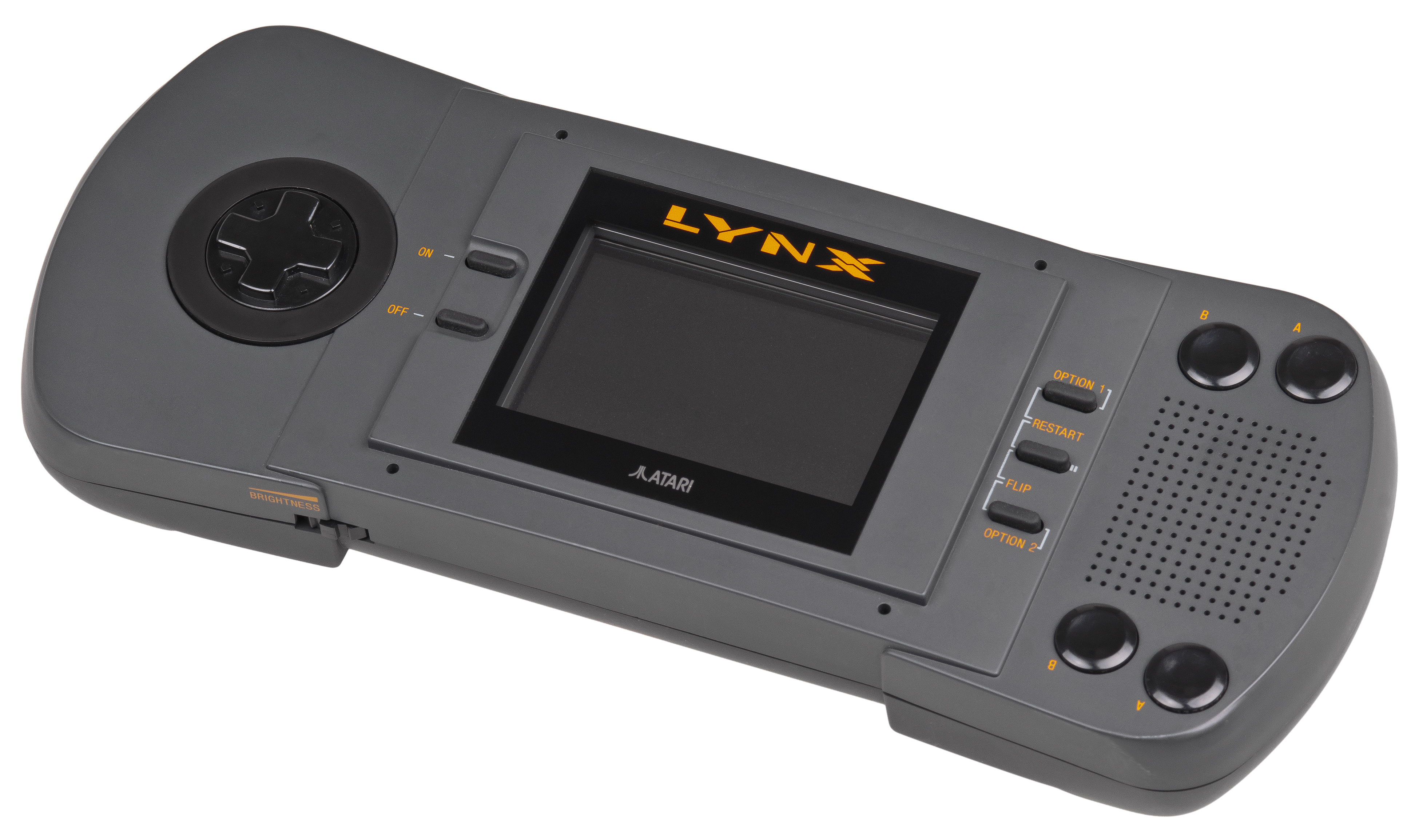
The interesting thing was, as the technology to make a powerful, handheld gaming system came into being, Nintendo wasn't the only company to be developing such a concept.  Epyx, a software company fresh off a handful of successful titles, began developing their own handheld gaming device in 1986, nearly a year before Game Boy designer Gunpei Yokoi began work on his handheld system.  Epyx didn't have the financial capabilities to mass produce their "Portable Computer Entertainment System", however, so Atari Corp. stepped in to help them make it a reality.  If only the Atari Lynx had debuted 6 months ahead of the Nintendo Game Boy, instead of the other way around, the gaming landscape might be somewhat different than it is today.  Would the Lynx have sold enough at its initial $179.99 price point to keep Nintendo from totally dominating the handheld gaming market?  Probably not, but the Game Boy might have been a bit less ubiquitous, and the poor Lynx might have become more than just the forgotten competitor from the worn out Atari.


The initial model of the Atari Lynx was quite large, and not nearly as portable as Nintendo's
Game Boy system, despite the latter still being a large, white plastic brick on its own.

While Tetris was a large part of the success of the Game Boy, due to its near-universal appeal, the fact that Nintendo marketed the Game Boy so well is another factor that contributed to its runaway success.  Unlike the Nintendo of the last decade or so, Nintendo in the late 1980's was dominating the market, but that didn't stop them from advertising their new product to anyone and everyone.  It was marketed as a fun system with a lot of games for kids.  It was marketed as "edgy" and "cool" to the teenage set.  It was also marketed toward adults, as a diversion from the doldrums of daily life.  Nintendo reaped the reward for all their efforts, as history has shown us, because the Game Boy line sold in the tens of millions within its first few years.


Nintendo successfully fused then-modern music and fast image cuts
with game footage to produce this kid-centric commercial.

Look at this hip 1989 teenage boy with his cool denim jacket, his, "I'm
ready for 1990" haircut, and his hot sneakers! Nerds like me, when I
was in school, would have looked up to him and his Game Boy.

I'd never seen this particular Game Boy TV spot before, but it truly
demonstrates the scope of Nintendo's advertising plan for the Game
Boy handheld. Serious, hard-working adults were just as much a
target as children, and many bought into the hype.

This is the adult-focused Game Boy commercial I remember seeing
as a kid, often watching prime time TV with my parents. Of course,
they weren't interested in such things, but many adults caught the fever.

Nintendo continues to dominate the dedicated handheld gaming market today, though the ubiquitous nature of smart phones has begun to eat into the overall market share.  Still, the fact that we're even playing games on our phones is itself a tribute to what Nintendo accomplished by putting real video games into our hands, not just LCD screens with static images and little interactivity.  The Game Boy was the first system to market that gave the consumer a true video game experience on the go, and it was affordable to do so.  They also wisely chose to include the ability to connect two Game Boy systems together via the Link Cable accessory, which came with the initial hardware, and worked with the system's pack-in game, as well as 2 of the other 5 US launch titles.  I spent many hours as a kid linking up with friends for head-to-head Tetris and Dr. Mario sessions, and after buying F-1 Race, I even got to play that against a friend or two.  It was the first time handheld gaming could be truly competitive as well, a feature that may well have been part of the inspiration for much of the online gaming boon many years later.

Another interesting thing about the Game Boy is that, despite the handheld lasting for nearly 10 years on the market (from its debut in April 1989 to the debut of the Game Boy Color in November 1998), there are only just over 500 original titles for the system.  Several games received "Million Seller" re-issues, and some games were later reissued by other publishers (such as Sunsoft re-issuing the Final Fantasy Legend games), but the total number of original, licensed games released in North America was just a shade over 500.  It seems odd that the Game Boy had so few games compared to the NES, which had somewhere in the 700+ range.  Having said that, the Game Boy did have basically twice the size of library as its closest competitor, Sega's Game Gear, and it dwarfed the library of the Atari Lynx, which topped out around 50 titles.  Despite all this, there are a number of Game Boy games that went on to spawn game series that have had lasting effects over the years.  From the sleeper hit Gargoyle's Quest (that produced 2 console sequels) to Kirby's Dream Land, which continues today in new and interesting iterations, and of course, the pervasive Pokémon series, which sold nearly 10 million copies in the United States alone, and as history has shown, became a worldwide phenomenon, right at the end of the Game Boy's life, all thanks to some innovative gameplay mechanics and the monster collection theme.  For a system 1 month away from the end of its life to have a game that became one of the system's best selling stand-alone titles is no easy feat.

This iconic clip is from the 1990's TV series, Picket Fences. I wasn't
allowed to watch the show, perhaps for obvious reasons, since the
themes of the show were a bit more mature in nature, but the sheer
mainstream saturation of the Game Boy was present in this show,
which was targeted more at adults and teens than kids.

It's easy to look back 25+ years and say that the Game Boy was a resounding success.  By contrast, I understand why some say that Nintendo is floundering with the Wii U, and to a lesser extent, their 3DS line-up of handheld systems, despite that continuing to be a money maker.  Even so, the market is a much different place now than it was during the time of the Game Boy, and there's far more competition for the same gaming space these days.  Smartphones have taken over where Nintendo's white brick once ruled, and even the 3DS (and Sony's poor Vita) struggles to continue to find an audience, amid free-to-play tower defense and puzzle games.  Still, all the hipsters, millennials, and soccer moms crushing candy and slashing fruit like a ninja owe the lion's share of that ubiquity to Nintendo, and their little handheld game system that could.  Without the Game Boy to begin that portable gaming revolution, you probably wouldn't be reading this article, because the lasting legacy of the Game Boy would have been far less important than it actually is.  For that, we all owe Nintendo a debt of gratitude.  I know my life would be less interesting without having spent a lot of time with my Game Boy as a kid, and even in more recent years as I've rekindled a love for the hobby.

Saturday, October 31, 2015

Radar Mission (1991)

Image shamelessly linked from Game Oldies. Once again, I find myself
in awe of late 80's, early 90's box art. The cool fonts, the excellent,
hand-drawn artwork, and blatant overstatement of the actual product.
Ah, nostalgia.

I love playing games.  I love video games, of course, because, if I didn't, writing this blog would be pretty silly of me, wouldn't it?  But I also love other kinds of games.  I grew up playing board games and card games with my family.  I can rock a game of Klondike Solitaire any time, and I rather enjoy trouncing my family in a rousing game of Scatergories.  Yes, I love a good tabletop game.  So do a lot of other people, I'd wager, which is why we see so many conversions of popular card, board, and other tabletop games on video game systems.  The Game Boy was no exception to this, and received a number of relevant titles.

Radar Mission, on paper, is the very definition of taking a board game and turning into a video game with enough added content, feature/functionality, and substance, to make it worth playing over and above the source material it shamelessly copies.  In this case, it's the venerable classic Battleship.  Yes, the game that invented the catch phrase, "You sank my battleship!" that nearly every North American child in my generation could pull out of the air, since during almost any commercial break for after-school programming, or Saturday Morning Cartoons (RIP), a commercial for some iteration of the game was inevitably aired.  The difference with Battleship, however, was that many versions of the game came with more than just plastic pegs, plastic ships, and a nice custom game board.  Some versions came with lights, sounds, and gripping nautical warfare action!  Okay, so maybe I'm channeling the commercials from memory, but the truth is, as a property to translate to the video game medium, Battleship had already transcended its pressed cardboard and plastic game piece brethren, and was therefore going to need more than just pictures on the screen and cutesy music to spruce it up.

And once again, we have a completely different game logo design
from the box to the title screen. Another case of the left hand and
the right hand not being aware of one another, methinks.

I suppose Nintendo was able to produce Radar Mission (or Kaisen Game: Radar Mission, in Japan) without having to pay Milton Bradley bucket-loads of money, because the game originated as a pen-and-paper game, and took on a number of physical board game revisions, before Milton Bradley's more famous Battleship game became a household name sometime during the late 1960's and early 1970's.  By the 1980's, of course, it had become a phenomenon, and I think it was almost a prerequisite that any American family had at least one Battleship game board in their house.  At least in my experience, I believe all my friends' families had the game, my grandmother had it, and they even had it at school where we could play during certain activity times.

Game A in Radar Mission sets itself apart by offering a number of features that its inspiration never boasted.  First and foremost, when you start the game, you get to choose what size of game board you want: 8x8, 10x10, or 12x12.  You only get to choose the size of the initial board, however, because, if you happen to defeat the enemy during the first match, you move on to a 2nd level with an 8x8 board, and then on to a 3rd and final level where you're attacking the enemy's base on land.  It gives the game a lot more depth than the traditional board game variety.  You have the ability to toggle a "Near Miss" feature, which means that, when you or your enemy fire a shot that lands in the water next to a ship, a warning sound will play, letting you know that in one of the spaces directly above, below, or to either side of your ship, there's a target you can hit.

Here you can see all the options available in Game A, like the ability
to have aircraft launch, near miss, and WHAT ON EARTH, is that
Hitler commanding your fleet? No wonder I lost so much!

There's also the "Lucky Shot" feature, which is triggered in a seemingly random fashion.  When you or your opponent miss a shot, you may be granted a lucky shot on your next turn.  There are 3 varieties: first a single square shot, which, if successful, will completely destroy a ship in 1 hit.  Second, there's a 5-shot blast which fires off 5 shots in the shape of an "X", and finally, a 9-shot volley that mirrors the 5-shot, but just stretches out 1 additional square diagonally from the center-point.  If toggled, you will be alerted of near misses with these, though it's still a guessing game as to what side the actual target will be on.  Then there's a nifty feature where, mid-way through a match, your aircraft carrier can launch a fighter jet, which will randomly move to different squares surrounding the location of the aircraft carrier (even after it has sunk), during each turn of the game.  If your opponent has sunk all your ships, but your jet is still in flight, you still have a chance to take them out, as long as they haven't taken it down.  It adds an additional strategic element, because of the need to hit what is, essentially, a moving target.  Finally, you can choose between 2 captains to command your fleet, and 3 different opponents to play against, though the actual choice doesn't matter, as each commander plays exactly the same.

It's a satisfying sight, seeing your enemy's ship go down in flames,
helpless to defend themselves against your missiles. No, I don't
need therapy; all is fair in love and war, remember?

Game B is where the biggest deviation from the Battleship formula comes in, as it has nothing to do with the board game, but is instead a submarine-based action shooting section, with a first-person perspective.  You control your sub, and can move left and right on the play field.  Pressing Down on the D-pad will submerge the craft, and you can move left and right while watching the radar map, then press Up on the D-pad to raise up out of the water, and put you back into first-person view so you can either torpedo enemy ships, or use your machine guns against the enemy sub.  Before each of the 3 rounds, you can equip your sub with a turbo propeller for additional speed, a twin-torpedo shot, for easier aiming, and powered sonar, which will reveal whether enemy vessels are moving left or right.  Occasionally, you'll see bags of money pop up on screen, which you can shoot to earn more money, which will help you buy those upgrades again for the next round.  Both you and your enemy start with the same number of ships each round, and the object is to blow up the last ship of your enemy's fleet before you can, or to blow up your foe's submarine, should you be so lucky.  In the first-person view, you may get an indicator arrow pointing left or right, as to which is the best direction to travel to reach the most enemy ships to take out.

As you can see, I've already taken out my opponent's aircraft carrier.
The area my targeting cursor is over happened to be the next ship I
hit.  It won't be long before it's blown to smithereens, sinking to the
bottom of the sea, forever to be nothing more than a relic of warfare.

Here's the tricky thing about Game A: the AI is all over the place.  As one would expect, the game attempts to approximate what a human would do, but sometimes it feels very random.  Anyone I've ever played Battleship against, once they've found one of your ships, they continue to fire in that region until they've sunk the vessel.  Sometimes, in Radar Mission, your enemy will hit your boat, fire a couple near miss shots which give them license to sink the vessel, and then, inexplicably, they'll begin firing on random spots on the board, seemingly in an attempt to find other ships.  It's a strategy I've honestly never seen, and it's a bit baffling.  I'm not complaining, however; Game A provides quite a challenge, and I only conquered my opponent after about 15 or 20 attempts, during a game where the CPU used the aforementioned tactic.  Apparently, my nautical warfare skills need some tightening up.

Finally seeing the smiling face of my fleet admiral and the celebratory
dance of my crew was quite a feeling, after being taken down so many
times. It felt good to finally win all 3 rounds and defeat the enemy.

Game B, however, really ups the ante in the area of challenge.  The enemy sub seems to have an innate sense of which direction to travel for maximum kill speed, and is relentless in firing machine guns and torpedoes at you when you cross its path.  My assumption is, because the other sub can destroy you, that you could also destroy it, but I haven't been able to accomplish this apparently herculean feat.  Rather, I have focused on taking out the opposing ships, but I've only ever been able to get past the first round, with a scant, single ship in my group remaining.  In the 2nd stage, assuming I earned enough money to buy all 3 power-ups again, I get absolutely creamed by the lousy enemy craft, and haven't seen the 3rd stage, as of yet.  Oh, and unless you're a masochist, or an absolute Jedi at games like this, don't even think about trying Game B without buying the upgrades before each round, because you'll probably lose.  Needless to say, Game B presents a pretty stiff challenge, though I suppose with enough practice, one could best the 3 stages and achieve victory.

These guys are the smart ones, who stayed back at the dock. They're
not going to be sunk by an opposing sub. No, they'll happily be sipping
beverages in the cantina, laughing at their comrades risking their necks.

In terms of the game's visual aesthetics, they're pretty well done.  The ships themselves aren't much to look at when you're looking at the game board, but the designs are nice, and the animations accompanying each volley are a nice touch, despite being a bit sparse.  Obviously being a slow-paced game, Game A gets by more on substance than flash, but then Game B has some nice touches, like the multi-level scrolling water that looks like a parallax scrolling effect, and a decent depth perception effect when firing torpedoes at far away ships.  The little animations in between stages are a bit goofy, but they're light-hearted, and serve their purpose.  I also kind of like the explosion effect graphics each time you destroy a ship.

I said it before, and I'll say it again. Get the upgrades, or prepare to be
annihilated within short order. Seriously, the enemy sub will cut you
down to size without a moment's hesitation, and you'll be crying.

The music in the game is well composed.  In Game A, there's a standard tune that plays during the bulk of the stage, and then toward the end of each round, the music will change, depending on you and your opponent's status.  If you are down to your last ship, the music becomes serious and ominous, as if to signal that you're in trouble.  If the enemy is down their last vessel, you get a more triumphant, victorious kind of theme that plays, signifying that you're in the home stretch with only 1 boat left to bomb.  When the opposition gets a lucky shot, another serious, frantic-toned ditty plays while they're targeting and firing, as a means of building tension.  The title screen theme is nice as well, with a catchy melody and a nice faux-military sort of feel.  Sound effects are also decent, with the usual "alley-oop" kind of high pitched whistle when firing missiles, a good explosion sound, and a serviceable splash-down sound for missed shots.  The near miss sound is a bit annoying, though one assumes that's the point.  Game B's main theme is a bit less memorable, though once you're down to 3 ships, it changes to the "ominous" theme from Game A, which serves to heighten the action.  I like how the music fades out on the option screens when you select your options and start the game, it's a nice effect.  Overall, the sound design is pretty solid.

There are moments like this in Game B that are very rewarding - the
second before the torpedo hits, you know it's going to find its target,
and you'll get to watch the glorious explosion of an enemy vessel.

It's hard to fault Radar Mission for much of anything, because, in 1991, the Game Boy was really hitting its stride, in terms of development teams really learning how to get the most out of the limited hardware.  The slow pace of Game A, coupled with the original DMG Game Boy model's blurriness, means that it was probably the perfect choice for car rides, weekends at grandma's house, and late night sleepover game sessions.  Game B, with its faster pace and fast scrolling ships, doesn't fare quite as well on the original hardware, but since the animation is relatively flat, it still works pretty well.  Nintendo took an established formula and added some nice additional features that really buoy the game (sorry, pun intended), and make it feel more fresh.  But instead of just stopping there, they added an entirely different 2nd mode, which gives the game even more replay value, especially since both game types can be played with 2 sea-faring swabbies (no, this isn't a pirate game, but go with me on this one).  Sadly, since I only have 1 copy of the game, I didn't get to experience that.  My only real complaint is that, for Game A, there's no mode that allows 2 players on the same device.  That would have been a fantastic addition to an otherwise well made game.  Had I known about Radar Mission back when it released, it might have, erm, "been on my radar" (sorry, I can't help myself), and might have been a game I would have purchased.  I know my younger brother would have played with me, and had there been a 2-player/1-device mode, I might even have convinced my dad to as well.  Regardless, anyone who owns a Game Boy (or compatible device), has fond memories of playing Battleship, and enjoys this kind of tactical strategy challenge, should be looking this game up and seriously thinking about acquiring a copy.  I got mine for $4 (loose cart), and I would think you could probably find a copy in the wild for around that price.  It's well worth that and more, and you could easily sink hours (okay, okay, I'll stop!) into it.  Highly recommended.

Unless you can master the submerging in Game B, you'll be seeing
this screen a whole lot like I did. Thankfully, once you do, avoiding
the other sub becomes a lot easier. You can also submerge to
avoid missiles fired at you by enemy planes, which comes in handy.