Sunday, June 28, 2015

SolarStriker (1990)

Image shamelessly linked from GameFAQs.
I love classic video game box art like this. It symbolizes
the imagination many artists put into the artwork. Imagination
that unfortunately, rarely ever captured the true look and
feel of the game. Still, it gave us hope of the contents within.

One of the video game genres that I've been a big fan of over the last 20 years or so is shoot-em-ups.  No, I'm not talking about "shooters", those fast-paced, first-person games where you brandish a firearm of some sort and snipe guys at 300 feet, reveling in every headshot.  No, I'm talking about the scrolling shooter, one of the staples of what we now know as classic, or "retro" gaming.  You see, from the early-mid 1980's, until around the mid-late 1990's, the scrolling shooter genre evolved tremendously, from humble beginnings like 1942, Vulgus, Star Force, and the like, to highly sophisticated games with deep, complex scoring systems like Battle Garegga, Dodonpachi, Radiant Silvergun, and many more.  While I appreciate the complexity and replayability of games like that, give me a simple "shmup" (a term, coined by Zzap!64 Magazine) with twitchy game play, a simple control scheme, and solid action any day.  While there's room in my heart for "danmaku" games (aka bullet curtain, or "bullet hell" shooters), I generally prefer classic shoot-em-ups to their more grown-up descendants.


Someone needed to remind companies during the 80's
and early 90's that changing the logo design between the
box and the title screen caused confusion. Which logo
was the "official" one, and which was a design mistake?

Leave it to Nintendo to do things differently.  While we know in today's modern world that Nintendo prefers to go their own way and do their own thing, in the late 1980's and early 1990's, it was everyone else who was doing their own thing, while Nintendo were the stalwarts of the scene, at least in North America.  We didn't know any better until years later, when we found out about the Tengen stuff, companies only being allowed to publish so many games each year for the NES, having to buy cartridges and hardware from Nintendo, etc.  During that time, Nintendo was leading the charge, and everyone else was either following, or trying to differentiate themselves somehow to stand out.  From the N64 forward, however, we saw a much different Nintendo.  So to some fans in 1990, a vertical scrolling shoot-em-up might have seemed like it came out of left field from Nintendo.  Be that as it may, they made a solid game.


"Space...the final frontier."  Also, graphically kind of boring.

The setup for SolarStriker reads like any other bog standard shmup from that time period.  You're a lone spacecraft either tasked with a suicide mission to save civilization, or a loner bent on revenge and the destruction of an alien planet/race/culture/technology/etc.  It doesn't matter much, as there's no story in-game, and the back of the box doesn't exactly give you much of a reason for blasting alien baddies, anyway.  What does matter is that you've got 3 lives, an upgrade-able weapons system, and tons of alien craft and weaponry in your way before you reach the end of the game's 6 stages.  Throughout your journey, you'll collect power-ups, destroy flying ships, tanks and trucks, alien life forms, and large boss enemies to reach the final showdown.


I'm sure you'll become quite acquainted with this screen
as I did in my play through of the game. It gets annoying.
Thankfully, you can press Start to jump right back to the
title screen, and Start again to get back to the action.

Graphically, the game isn't too shabby for the Game Boy.  Your ship, while devoid of a "tilt" animation when you move left to right, is rendered nicely, and the backgrounds generally strike that balance between interesting and utilitarian, leaning more toward the latter in favor of the player's ability to see what's going on.  Enemies move in various patterns, and while some enemies rotate or change as they attack, others just move on the screen and their sprites are static; only their movement fluctuates.  Explosions are also decent, given the small screen size, but they don't distract from the action.  As a side note, this game was released early enough in the Game Boy's life cycle that it has a special palette programmed into the Super Game Boy, Game Boy Color, Game Boy Advance, and Game Boy Player which reverses the "black and white" contrast, so that space looks like space with black space and white stars, and similar changes.  If you want the original experience, you'll need to play it on an original DMG or Game Boy Pocket unit, otherwise, you'll see the game much differently than R&D 1 had in mind.


I can only assume since we started in space, and this is
Stage 2, we're in the sky above the alien planet, raining
down destruction and chaos everywhere.  Neat.

The audio of the game is an area that I think was relatively strong, given the time of the game's release.There are only a handful of music tracks in the game.  The title screen has its own ominous theme, and then there are 3 tracks shared by the subsequent 6 stages, each track playing for 2 consecutive stages before the next theme is used.  There's a separate track for boss fights, and then of course, separate music for when you lose your last life, and for the game's ending.  All tracks are reasonably well composed, though I'll wager that most people will say the Stage 1/2 music is the best tune in the game, in part because it's super catchy, but also because that's the music they'll likely be hearing the most.  Sound effects are also decent, though very minimal, using white noise bits for explosions, sufficient beeping and noises for your craft firing, etc.  Most enemies don't make noise when they fire projectiles, so you don't get that extra warning - you'll have to be mindful of their incoming fire by sight only.


Stage 3 goes over some roadways, which look suspiciously
like our own on Earth.  Wait a minute, am I blowing away
aliens on Earth? Why didn't anyone tell me?

Game play is pretty standard.  You can move the ship up, down, left, and right on the screen, and have no real restrictions as to where you can go within the game's field of vision.  The actual stage width is greater than what you can see on screen, so as you move the space ship left and right, the screen scrolls slightly to display the rest of the area you have to fly in.  It feels natural, and didn't distract me when playing like in some games.  The difficulty is pretty standard throughout the first 3 stages, increasing relatively gradually, though the bosses for the 1st 3 areas are quite easy.  Things get very hairy starting with Stage 4, however, as the difficulty ramps up quite a bit.  In particular, the Stage 4 boss rains down a lot of fire on your ship, making it quite tough to get in a few hits here and there.  The Stage 5 boss is only slightly less forgiving, having a more predictable pattern.  From Stage 4 through 6, there are mini-bosses, and there's a small mini-boss rush at the end of Stage 6 before the final boss.  Strangely, though the final boss throws a lot at you, it feels like a less complicated battle than the 2 preceding boss fights, so it comes off as a bit of a relief in comparison.


Stage 4 adds the first mini-boss, this big fella here. You
have to destroy the shielded units around him to get to
the actual core of the unit itself, not unlike another famous
series of shmups where you have to "Shoot the core!"

This is a shooter based on the template laid down by a number of arcade and early console titles that came before it, and in some ways, served as a template for all shoot-em-ups subsequently released for this platform.  There's not a 2nd loop for "New Game Plus" mode, and there's not even a high score table.  You just fly, maneuver, and shoot through 6 stages, and that's all there is.  It's not a particularly long game, though the stages themselves are sufficiently long before the boss encounters.  Yes, the game comes off as a pretty no-frills affair, but for a portable title, that's pretty much all you need.  It's a solid game with tight game play.


This is the Stage 4 boss, just before it starts shooting a
metric ton of bullets at me. This was long before the term
"bullet hell" was coined, but that's not far off the mark here.

If I had to level some complaints against SolarStriker, I would say the game's major difficulty spike after Stage 3 would be one.  The game just doesn't feel that hard through the first 3 levels, once you memorize enemy wave patterns.  Starting with Stage 4, however, things become much more manic.  You start to encounter fast moving enemies that can only be destroyed at the highest level of ship fire, and even then, only if you're at the bottom of the screen firing at them constantly until they're nearly on top of you.  The enemy bullet timing and patterns are kind of goofy as well.  Sometimes it feels like they're targeting you, while other times, it seems like they're just shooting a bullet, hoping to hit something.  In later levels, when half the enemies start shooting directional lasers that always shoot straight down, it becomes less twitch-reflex dodging, and more risk/reward, where you decide whether or not you want to risk potentially being taken out by a laser, versus the points you'll earn for destroying that enemy or group.  It's a little unbalanced in that sense, and is a bit too obvious in the game's setup.  I also would have liked the other 2 stage tunes to be a bit more memorable, or better yet, have dedicated music for each of the 6 stages.


Oh look, a stage that looks like highly advanced
technology and stuff - that's not a trope at all, is it?

Despite these less than perfect design choices, SolarStriker remains a highly playable, and reasonably enjoyable game.  It's a solid shmup that benefits from some good graphic design choices to make the game easy to see and play on the original hardware, despite the Game Boy DMG's tendency toward motion blur.  The music and sound, despite the sparse nature of it, is fitting to the game, and you'll likely find yourself whistling or humming the Stage 1/2 song at some point.  Just don't throw your Game Boy against the wall when you die on the Stage 4 boss the 12th time.  I'll give this 2 thumbs up for shooter and arcade game fans, and a casual recommendation to anyone else.  It's a very common game, and I picked up a copy for $4.  If you can't find it that cheap, it might be worth paying a little more for, but I wouldn't go out of your way to acquire it, because it's so common in the wild.


The final stage looks vaguely like you're inside some giant
alien being, not unlike Life Force/Salamander or Abadox. The
final boss appears to be the creature's heart that you have
to destroy. Why it shoots bullets at you is anyone's guess.

Yeah, we kind of figured that part out with the preceding
cut scene, but thanks for telling us anyway.

"Finally, I can dock my ship and go meet up
with that cute engineer from Section 3!"
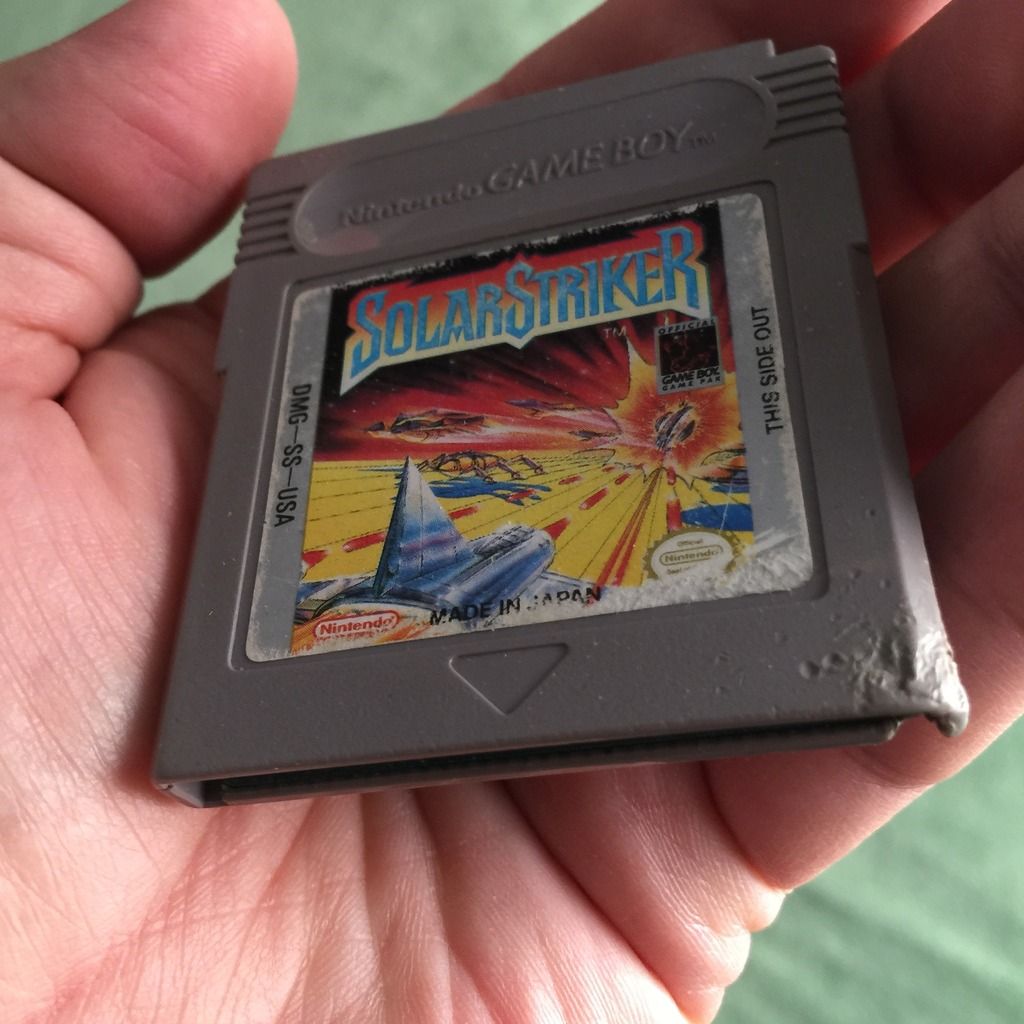
This is my SolarStriker cart. It appears that perhaps my
cart fought in the conflict with the aliens alongside the
space ship you pilot in game...

Saturday, June 13, 2015

Nail 'n Scale (1990)

Image shamelessly linked from Game FAQs.
Flying lizards, giant bugs, robots, and dragons as
enemies? Count me in! Wait, what's with the nails?
,
The mid-late 1980's, and early 1990's were a magical time.  Forget Iran-Contra, forget Black Friday, forget the rampant materialism of the Baby Boomer generation, forget "yuppies", and forget the Gulf War.  During that period of time, we had Teenage Mutant Ninja Turtles and Karate Kid, G.I. Joe and Transformers, Ghostbusters and Honey, I Shrunk the Kids!, and so much more.  And we had video games.  If you're reading this, you're likely either from my generation, and have fond memories of the 80's and early 90's, or you're experiencing them for the first time, something I often wish I could do, as I approach 40 years of age.  For those in the latter camp, I envy you.

So, the logo doesn't match the box art logo, but it still
makes it looks like the game will be more "bad" than
it actually turns out to be, with its extra wide drop-shadow.

One of the things any child of the 80's and early 90's can tell you is that, in the pre-internet age, we had to take a chance any time we bought a new video game, music album, or other medium that we couldn't preview ahead of time, like theatrical release movies.  With that, we often had to literally "judge a book by its cover", by interpreting the cover art for a new video game or album/CD we wanted, and try to make decisive purchases based on our reaction to an artist's rendering on the front cover.  Depending on your viewpoint, i.e. glass half empty or glass half full, it was either a total crap shoot, or an adventure that always had an element of "danger" to it.  Would your purchase be rewarded with an excellent experience that you would cherish for years to come?  Or, would your hopes be dashed, as you discovered that the artist, whose work adorned the front cover of the purchased item, let you down by painting something that didn't truly communicate what you were getting?

The game starts out pretty slow, with very minimal work
required to get to the exit door. It does a good job of
teaching you how to play by introducing elements slowly.

Nail 'n Scale, by then stalwart publisher Data East, sort of fell into that trap.  Based on the cover art on the box & cartridge, it looked like an intense journey through a unique world, where formidable enemies besieged you at every turn, you clung to life while hanging from nothing but a large nail, traversing vast expanses of blocks and platforms suspended in mid-air.  The artist gets it half right, but the menacing enemy designs, combined with the highly stylized, chrome logo akin to that of the era's heavy metal bands, promised a much more frenzied experience than what was delivered.  Having said that, it's not a bad game.  As a matter of fact, it's a fun little romp.

You'll quickly learn how to break blocks under your feet,
a vital skill in this game, especially in later levels.

Here's the setup: you're Spike, an unassuming guy, presumably a construction worker of some kind, who, for reasons unknown, is trying to scale walls in a building that is made up of all square blocks of different make-up, and in each room, your goal is to find the door to escape each room.  How you get dropped into each of these rooms is unclear, but you must escape.  After 9 stages of scaling walls, fighting or dodging enemies, and finding doors, you encounter a boss character, usually an over-sized animal of some sort, who always spits out some kind of projectile at you.  Once you discover their weak spot and hit them several times with your nails (or spikes), you defeat them and it's on to the next 9 levels of climbing action.  Your only weapon, which doubles as a tool to help you climb walls, is an endless supply of nails/spikes, which you can throw either to the left or right of you, straight up, or straight down.  You also have the ability to jump, including a unique mechanic where you can jump in mid-air, provided you have stepped off a platform.  This feature becomes a critical component in the game as you traverse through the various levels.

"Some like it hot and some sweat when the heat is on."

The impetus behind the name is the way you get from place to place in the game.  There are several types of blocks in the game, some of which you can toss your nails into and they'll stick.  If you throw a spike into a brick horizontally, you can then stand atop that brick.  If it's a plain "white" or "gray" brick, jumping on that nail twice will break and destroy that brick.  If it's one of 2 or 3 other varieties, the block won't break, and you can continue to stand or jump on that nail until it vanishes within a few seconds.  If you throw a nail downward, you can do the same thing, breaking a brick by jumping on top of the nail's head.  For large groupings of blocks that you need to break into, you can use a horizontal break to open a hole, then use a vertical throw to stick a nail into the corner of the next brick you want to break, then jump on top of it.  This has been dubbed "corner breaking" by those who have written FAQs on the game, and it's a technique you'll want to master, along with the mid-air jumping.  Some blocks cannot be pierced with spikes, so you'll need to be cognizant of those as well, knowing when you have to find an alternative path or way to scale the heights.  You have 3 power-up icons available to you, should you find and accumulate them through play.  The "white" nail will pierce bricks as normal, but breakable bricks will not be broken by standing on these nails.  Striped spikes are explosive, so once you throw one, get out of the way, because the blast radius is just a bit larger than what the explosion animation would lead you to believe.  And, for those who give up easily, there's a small door icon you can grab, and using that power-up will allow you to simply skip a level, effectively creating an exit door wherever you're standing.  Oh, and to keep things interesting, none of these powerups are available during boss fights.  As with most puzzle platformers, one hit and you die, fall into a fire pit and you die, etc.  Some enemies are impervious to your spikes as well, so they'll just need to be avoided.

At first blush, this looks like an insurmountable level.
Pause the game, look around, and learn quickly how
to corner break, and you'll figure it out soon enough.

Nail 'n Scale suffers from a few issues.  First and foremost, the game was released in 1990 as Dragon Tail by Japanese developer I'Max, and wasn't localized in the west until 1992.  By then, developers had really begun to eek a lot of impressive things from the Game Boy, so by the time this game hit our shores nearly a year and a half late, it had been eclipsed in the audio-visual department by nearly everything else out there at the same time.  The game is also somewhat unique, which works in its favor, and I felt it was relatively intuitive, but the concept of throwing nails into walls and jumping on them to break them seems like a dated, hold-over kind of idea from the early arcade development days.  I'Max did something interesting with it, but on paper (and on the back of the box), it doesn't sound that appealing.  As you get into later levels, some of the puzzles become very obtuse, requiring odd choices as far as your character's path through a level.  Unless you can figure out the one most effective way to beat a level, you may end up "cheating" slightly, and racking up exploding spikes by dying once or twice after collecting them so you can stockpile a bit to help you get through a level.  Once you get up past level 40, the game also becomes quite punishing, even on the Easy difficulty level.  Some of the precision required to complete a couple of the last levels is downright maddening.  When you crank up the difficulty to Hard, it cuts your jump height by roughly 1/3, so those precision jumps become nigh impossible without pixel-perfect accuracy and timing in their execution.  The game has 50 levels, but lacks a password system, so if you want to complete it, even with unlimited continues, expect to play for an extended period of time.  Works in theory, but for a portable system, it would be especially useful to have a password every 5-10 levels, especially with as many tries as some levels may take to solve.


I won't show you the level, because it's devious and evil.
Given its number, however, I'm convinced that mastermind
Milo Rambaldi was involved in its layout & construction.

Despite the game's flaws, I had a lot of fun with it, and if you're anything like me, you'll have that "Eureka!" moment from time to time when you figure out a particularly hard level.  It helps that you can pause the game and use the D-pad to look at the entire layout of the level, sans enemies, to plan out your strategy, and that certainly makes the game a bit more forgiving.  Having said that, the fact that level 43 and up on Easy Mode made me want to pull my hair out, I'd say my motivation to play on Hard Mode is pretty much zero.  When I discovered this game out in the wild, there were 2 loose carts side by side in a display case, priced at $15.  I asked the clerk if there was any wiggle room, and she checked the computer to discover that both should have been priced at $10.  I had enough fun over many weeks to justify that price, but I wouldn't recommend paying any more for it loose, despite the fact that it's probably not a particularly common cart.  It won't change your world, and it's one that, unless you pull it out every few years to refresh your memory on the puzzles, probably won't be frequenting your Game Boy much.  Recommended for puzzle platform nuts, and casually recommended for anyone else if you can pick it up cheap.

Turns out, this is the "dragon" part of the game's original
Japanese title, "Dragon Tail".  You face him as the last boss,
though this screen looks far more dragon-like than what
you actually see when you're fighting him.

Saturday, May 23, 2015

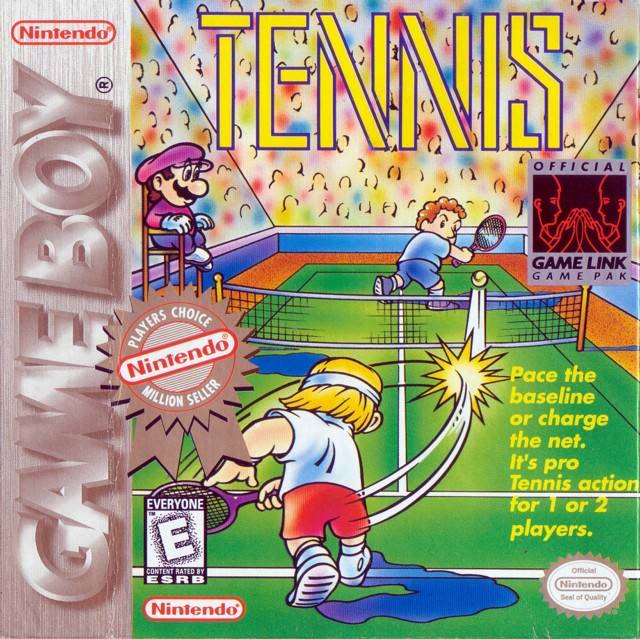
Tennis (1989)

Image shamelessly linked from GameFAQs.
2 out of 5 Game Boy launch titles were sports games.
I'm not sure what that says about Nintendo, but it does
make me wonder why every platform got so many.

So this is Tennis, the final of 5 launch titles for the Nintendo Game Boy.  The 2nd of 2 sports titles in the launch line-up, Nintendo of America must really have been banking on the popularity of sports games, because the launch line-up included 2 games, much like the Japanese launch included Yakuman, a mahjong game.  In the same way that every video game console ever released in Japan has likely seen a mahjong game (or thirty), every game system ever released in North America is generally peppered with sports titles throughout the console's life span.  The Game Boy was no exception, and it received both Baseball and Tennis.

It's a good thing they let you turn off the background
music, because there's only 1 track that repeats forever.

Of the 2 sports titles, I prefer Tennis, in part because it's a more fully realized game.  Baseball suffered from very little replay value, somewhat broken game mechanics, and a touch of unforgiving CPU AI.  Tennis, on the other hand, appears to be more fleshed out, in part because there are 4 different difficulty levels, and the gameplay just "feels" better.  Something about how tightly the game plays makes it a better game.  I realize that's difficult to quantify, but I'll do my best to explain.

There are 4 different difficulty levels. Each successive
level makes the game faster and more difficult. I'm not
sure how human beings can play the game at level 3 or 4,
given how fast the game, you, & your opponent both move.

For the uninitiated, the sport of tennis is fairly simple.  2 players face off on a court with a 3 1/2 foot net that divides the court equally.  Each side has lines painted to designate the entire play field, as well as two smaller sections along the net that show the serving area.  One player serves the ball by hitting it with their tennis racket to the opposite court, on the opposite side of the net horizontally.  In other words, they hit the ball diagonally to the player on the other side.  That player then returns the ball to anywhere in the serving player's side of the court, and they continue to volley the ball back and forth until someone misses a shot, one player hits the ball out of bounds, or the ball hits the net and lands on the side of the returning player.  The 1st and 2nd scores are worth 15 points, the 3rd is worth 10, and the 4th wins the game.  If each player scores 3 times, and they're tied at 40 points, a "deuce" occurs, and the players continue to serve and volley the ball until one player has scored twice in succession against the other player, so that they are 2 strokes or volleys ahead.  This particular tennis game consists of 2 sets, consisting of anywhere from 6 to 12 matches per set, depending on whether the players are winning multiple matches in each set or not.  If the 2nd set results in a tie, a sudden-death round takes place, and players volley until one player has scored 7 times, at which point they win the game.  Clear as mud, right?

As you can see, the view is pretty basic, but is perfect for
the game, because it's not cluttered by scenery or other
background noise that would detract from your ability
to just play the game of tennis, so it fits this game well.

The game's controls make for part of why I mentioned above that the game feels tighter and better than Baseball.  Holding up on the D-pad means you're hitting the ball toward your opponent harder/faster, and holding down means you're hitting it with less force.  Holding right or left on the D-pad when serving or returning a volley will make the ball veer in that direction, but be careful; sometimes you'll end up overshooting and the ball will land out of bounds.  Press A once to toss the ball in the air, and A again to serve.  The A button is your basic, straight-ahead shot, while the B button is a high, arcing shot where you essentially lob the ball up and over toward your opponent.  Start pauses the game, and that can be done at any time during a match.  Other than sometimes overshooting, and occasionally failing to return a volley if you're standing dead-center with the ball as it approaches you, the controls just work, and are pretty intuitive.

After every few matches, you change sides, as per official
tennis rules, though it doesn't really affect play at all.

It's not hard for a game to be more graphically impressive than the original Baseball for Game Boy, but Tennis is relatively impressive, as compared to its launch title sports brethren.  The character sprites animate well, and are reasonably good facsimiles of real people on a court.  The perspective above and behind the player is also just about as good as one could hope for, with enough view of both sides of the court to judge the distance, speed, and trajectory of the tennis ball.  The ball makes a subtle little circle animation on the ground each time it bounces, and the ball's shadow helps make it easier to gauge its relative position.  Mario looks like Mario, in his referee role, and while the crowd is pretty basic, at least there's an audience drawn in.  Overall, the graphics are fitting, and the animations work well.  There's also the nice little touch of your player bouncing the ball on the ground a couple times, if you take too long before serving the ball.  Also of note, all the original launch titles have special color schemes when used in the Super Game Boy, Game Boy Color, Game Boy Advance, and also the Game Boy Player for the GameCube.  The court is a nice green, the players have different color clothing, and it just looks very sharp.

Depending on the difficulty level, gameplay can get quite
fast and frenetic, with you and the CPU trading volleys in
rapid succession until someone makes a mistake.

Sound design is basic and utilitarian, but it works.  There's a basic ball bounce sound you'll hear a lot, as well as the sound when the ball hits the racket.  When a ball is hit high, it makes a familiar "arc" kind of sound, and when the ball smacks into the net, it's a good approximation of what that might sound like, at least as far what the Game Boy can produce.  The sound that plays between matches is goofy, and seems more like filler, but the "crowd noise" sound is decent, giving that sense of the audience cheering you on.  Music is basic, and like Baseball, the presence of only 1 music track means you'll get tired of it really quickly, but at least it's reasonably bouncy, catchy, and inoffensive, so until you tire of it, it won't completely bore you.  Once again, Nintendo gets the job done without the "wow" factor.

With enough practice, you can begin to get a leg up on
the CPU.  Also, you should win, because you have the
awesome, 80's-inspired headband on your player's head.


When I first started playing, I felt as though the game was quite difficult, because I found myself trying to beat the CPU by tricking it, using the right and left angled shots to send the ball where the computer couldn't reach it, only to be flabbergasted when it actually returned the ball in the same fashion I was attempting to do, and beating me handily in the process.  When I started to change up my strategy, alternating between fast and slow shots, and occasionally throwing in a "lob" shot, I started improving.  However, I found that there's a way to game the system, and give yourself a very good chance of winning.  If you stand at the back of the court, and hit the ball with a slow shot (hold down on the D-pad and hit A, just as the ball is reaching the back court line, you can shoot it just far enough to hit the top of the net and barely bounce over.  The CPU will not be able to return these shots, and usually won't try.  Occasionally, it will attempt to volley it back to you, but the ball will always hit the net on those occasions.  Of course, this technique becomes harder as you move up in difficulty level, so your level of precision needs to tighten alongside that shift.  There are other techniques more advanced that you can read about on GameFAQs, though strangely, none of the hosted FAQs mentioned this particular technique.  However, they all mention a bug in the game, whereby you swing your racket at the peak of your serve, then move your player so the ball bounces on your head and you win the point.  I can confirm their findings as well, as I tried it, and sure enough; it works like a charm!

It's good to know that, even after taking such a beating,
my CPU opponent isn't a poor sport, and will still shake
my hand.  Nintendo obviously didn't program in any John
McEnroe-esque temper tantrums in the game.

Unfortunately, since I don't know anyone else locally who owns a Game Boy, let alone someone who owns a copy of Tennis for the handheld, I was unable to test the 2-player mode at this time.  Based on what I've read, it's pretty fun, and you even have the opportunity to play doubles.  I would love to be able to try that, as well as competitive play against another person.  I quite enjoyed 2-player action on the Game Boy as a kid, and I still think it would be fun to have that kind of interaction today.  I suppose I could cheat, and try to play against someone online via an emulator, but I prefer the real thing.  There's nothing like hooking up a link cable, or lining up your Game Boy Color units for infrared to go head-to-head in a game like this.  Sadly, I can't test that side of the experience at the moment.

Ah yes, the triumphant walk to bask in the glory of victory,
as the audience cheers you on, feeding your narcissism.

Overall, Tennis on the Game Boy is a great little game, and one that I see myself going back to.  There are other tennis games on the platform, as well as titles that came out later on the Game Boy Color and Game Boy Advance, so it will be interesting to see how those compare with this.  As it stands, I would say this ranks behind Tetris and Super Mario Land as a decent 3rd place contender within the launch line-up.  It has more replay value than either Alleyway or Baseball, has better control and game mechanics than the latter, and is just fun to play.  Even if you're like me, and not much of a sports (or sports game) fan, this is a solid, fun game that, given some time, might just suck you in and get you addicted to it.  Recommended.

The painful sting of loss is too much for your player when
you lose - he just walks off the court crying after the match.

Thursday, May 14, 2015

Alleyway (1989)

Box scan shamelessly linked from Wikipedia.
Now Mario is piloting a suppository?  What's next?
Will he be the CEO of a major corporation?

Every game system that has ever existed has had a handful of lackluster or underwhelming games, either at launch, or during the "launch window", an indeterminate number of weeks or months following a console's relese, where games are released that are among the system's earliest titles.  Some of these games are still fondly remembered, or at the very least, are sought after because of collectibility.  In particular, I'm thinking of the Nintendo Entertainment System "black box" titles.  There probably aren't a lot of people who would stand up and say Clu Clu Land, or perhaps Gumshoe, are among the best early NES games, but they're still sought after as collectibles.


200 is a pretty low score, so besting the default high
score is a pretty easy task, even for the beginner.

Then you have console launch titles that aren't particularly well regarded or remembered.  There might not be anything inherently "wrong" with them, per se, but they didn't set the world on fire, so they tend to be relegated to bargain bins and priced to sell.  Mom & pop retro game stores might have 15 copies in their back room, but only 2 on the shelf, so they don't make it appear that there are as many copies in circulation, hopefully to help them sell a bit faster.  Shortly after they finally sell a copy, they bring out another to take its place, in hopes that they won't have 3 more copies traded in before they can clear some of the inventory out.  Alleyway exists in this space, perhaps somewhat unfairly.


Once you're down to the last few bricks, it can sometimes
take a while to get the ball to bounce where you want it
in order to take out those last few, which can be frustrating.

At its heart, Alleyway is a simplistic Breakout clone.  It offers very little in the way of features or exciting gameplay mechanics.  As pointed out in the excellent write-up Jeremy Parish did on Game Boy World, Alleyway is actually based upon an old Nintendo IP called "Block Kuzushi", which was one of a number of single-game consoles released in the 1970's.  I won't go into more detail, since Jeremy pretty much covered everything, but Alleyway plays more like a love letter to the earliest "paddle and ball" brick-breaking games than any of the more advanced games since, such as the excellent Arkanoid.  As a simple "paddle and ball" game, it succeeds and can be quite fun.


You can pause while the ball is in play, but not before,
which is quite strange.  If you hadn't started the ball, and
you accidentally press a button when you set your Game Boy
down, you will likely lose that life by default.

The setup of the game is very simple as well.  You begin with a basic stage, consisting of a grouping (or several groupings) of blocks, and as soon as you press a button, the ball is in play, and you're bouncing it off your paddle and up to bricks or against walls or other obstacles.  Once you clear that board, you're treated to the same level again, but where the brick grouping(s) will scroll to the right or left, necessitating a minor adjustment in strategy to get the ball to go where you want it to destroy all the bricks.  The 3rd stage offers the same layout again, but after every few times the ball hits the paddle, the screen moves down a bit, and the brick grouping(s) will begin to disappear, in favor of a 2nd grouping that will come down from the top of the screen.  After these 3 stage iterations, you're treated to a timed bonus round, each of which has a giant brick group shaped like a Super Mario Bros. character or enemy.  The bricks in the bonus rounds don't send the ball bouncing back down, and it essentially "collects" these bonus bricks as it passes through them.  If you collect all the bricks in the bonus round, you get an additional batch of bonus points.  There are also 3 types of bricks: "white" bricks garner 1 point each, "gray" bricks are worth 2 points, and the "black" bricks are worth 3 points.  For every 1,000 points you earn, you earn an extra life.  Also, when the ball reaches and touches the top of the playing field, your paddle shrinks in width by half.


All the bonus rounds have fun layouts like this Piranha
Plant, and they're all inspired by Mario universe characters.

Graphically, the game is almost as simple as it gets.  The paddle, though not a single shaded rectangle, like in the original Breakout, is very simple in design.  Most bricks have a basic outline around them, and there are some unbreakable bricks with a sort of "pyramid" look about them, with an "X" on the block and slanted, triangular sides.  Other than the ball bouncing around, the brick groups moving, the paddle moving left or right, and Mario jumping out of the paddle when you've lost your last life, the animation in the game is almost nonexistent.  Given the context of the era, however, and how previous handheld games consisted of LCD games, this can be somewhat forgiven, since this was a more fully realized product than those earlier games could boast.  Still, even for a launch title, it's a bit underwhelming.


Stage layouts become increasingly complex and varied as
the game goes on, forcing you to change up strategies.

Sound design is very basic.  The only time music plays is at the title screen, at the beginning of the bonus stage, and then during the bonus stage, once you press a button to launch the ball.  You also get a short ditty when you complete a level, or when you've lost your last life and the game is over.  Sound effects are mostly higher pitched beeps and things, such as when the ball hits various bricks, the paddle, the wall, unbreakable blocks, etc.  There is a decent explosion noise when the ball is lost, or when the time runs out in the bonus round.  In keeping with the inclusion of Mario in the game, you also hear the traditional 1up sound from the Super Mario games, each time you get an extra life.  Otherwise, the sound is underwhelming as well - it's just all very functional.


This Mario head-themed layout is a nice change of pace
from the more bland groupings of bricks in earlier levels.

There are 2 things that elevate the game above a standard Breakout clone.  First, the A and B buttons can be used to affect the paddle's speed.  Holding down the B button will slow the paddle's movement, and holding down the A button will speed it up.  I find that 90% of the time, I don't need those things, but on occasion, I'll use the B button to move the paddle ever so slightly so I can get a different angle of reflection on the paddle so the ball will go elsewhere, or will use A to speed the paddle up if the ball went somewhere I wasn't expecting it to, and I have to traverse most of the screen width to catch it.  That gives more depth and control than you'd get from a paddle and ball game without using an analog controller.  Second, the varied brick groups and level designs help keep the game from being the same rote exercise each time through.  True, you see each layout 3 times, but the way you interact with them changes a bit each time, so it helps to keep it fresh.  The bonus stages add a bit of fun, and the game does pose a challenge.  In all the years I've had this game, I've still never been able to beat it.  I always make too many mistakes about 2/3 of the way through the game's 32 levels, and lose all my lives.


Some later levels have a lot of bricks, so point scoring
opportunities increase quite a bit, which helps you earn
more lives to offset the ones you'll likely lose due to the 
more difficult layouts you'll have to contend with.

I feel like Alleyway sometimes gets unfairly panned, simply because it's not an outstanding title, or because it's not that memorable.  It's true, the game is very basic, and only hints at what the Game Boy was truly capable of doing, but to any kid just buying his or her first real handheld gaming system, it was still far more impressive than that Castlevania: Simon's Quest Tiger handheld they might have received the year prior.  The game doesn't do anything remarkable, but then, it doesn't really need to.  It's the perfect kind of game for a system like the Game Boy, because it's a pick-up and play sort of game, that you can play for a bit and put down, but there are enough levels and challenge that you can continue to play and it gives enough content to keep coming back to it for a while, until you complete it.  Once you've beat all the levels, there's probably not a reason to play it again, unless you're in the mood for this type of game, but then, lots of games are like that.  I'll give this one a casual recommendation, because loose carts can be had for $3 or $4 usually, and it's worth that much to experience it at least once, to get perspective on what the launch library was like, compared to what developers could get out of the hardware just 2 or 3 short years later.

Saturday, May 9, 2015

Baseball (1989)

Image shamelessly linked from GameFAQs.
"Take me out to the ballgame, take me out to the crowd..."

I'm not a sports guy.  Truth be told, I never really have been, though I did have some relative interest in sports as a kid.  I was sort of into football, I was sort of into basketball, and I had a passing interest in a couple other sports.  The sport I was most interested in, like many other red-blooded American youth, was Baseball.  Yes, America's pastime was my preferred sport, in part because of the strategy, and in part because that's what my dad was into.  My team was the Kansas City Royals, in part because of their proximity to where we lived, and my favorite player was the pine tar king himself, George Brett.  Needless to say, as a chubby nerd of a kid, I played exactly one summer of little league and played poorly enough that I didn't feel like playing a 2nd year.  Once the player strike happened, I quit collecting baseball cards and pretty much lost all interest in the sport.  I guess I had no sympathy for guys who made more money in a month than my dad made all year, and them whining about not getting paid enough.

I like how the baseballs and bats are incorporated into the title screen.

So while I haven't followed the sport in well over 20 years, I still understand the basics, and have played and enjoyed a handful of baseball games over the years.  The classic RBI Baseball on the NES was a hoot, and I had a little fun with Bottom of the 9th, an arcade classic that had semi-realistic (at the time) graphics and physics.  I even had some fun with Baseball on the Atari 2600, until the joystick stopped working.  But I never purchased a baseball game for any home console, because I'd rather go throw the ball around outside than play the game inside.  My first official baseball game purchase ever is Baseball for the Game Boy, a launch title.

"Swing, batter batter, swing!"

As baseball games go, this is pretty bare bones.  There are only 2 teams in the game, The W-Bears and the R-Eagles, and you choose which team you want to be based upon whether you want to hit or pitch first.  You can also choose between "USA Mode" or "Japan Mode", but as far as I can tell, the only difference between the 2 modes is the names of the players, which are all generic, save for Mario and Luigi.  The brothers don't appear to look like their more famous plumbing counterparts, however, as the player sprites are all quite generic.  The game mechanics are extremely simple as well.  If you're looking for a deep sports game experience, this isn't it.

"That's a mighty fast pitch ya got there, son."

Graphically, it's a pretty simple setup.  The view is the same, whether you're pitching or hitting, which is a view from behind home plate, as if you were the umpire.  When the ball is hit, the view switches to a more overhead perspective, and zooms out quite a bit so you can see more of the field and the players.  As expected, the player sprites are simplistic and have very little animation to them.  The graphics don't have to be fancy, given the need to see the field lines, bases, and players, so one wouldn't have to expect them to be anything more than what they are.  The animations are also a bit goofy at times.  While the pitching and batting animations are solid, and look quite good, the running animation is strange, especially when the pitcher runs to the mound at the beginning of each change-over.  The screen animation following a hit is also very jerky, and can be a tad distracting.

Here's me, throwing to 1st base instead of home because,
even with the game's intuitive controls, I keep wanting to
throw to 1st base for some odd reason...

Sound design is very basic as well.  The little tune that plays at the beginning of the game, as well as the one between rounds, will get stuck in your head, because they're catchy.  The song that plays during the game loops forever, and it's the only long-form track in the whole game, so if you don't choose to turn the music off (thankfully, that's an option), you're a better person than I am.  Sound effects are all appropriate for the game, and only the "pop fly" sound began to grate on me after a while.  At this point in the Game Boy's life, Nintendo wasn't experimenting too much with the sound hardware, and it shows here, because nearly all the sounds are pretty standard high-pitched "boops and beeps", much like what you would hear in early NES titles, before creative developers like Sunsoft started to push the envelope.

Each time you change players on the field, they do this
goofy thing where they all put up their hands when the
pitcher reaches the mound.

Gameplay is quite simple, mostly intuitive, but actually quite difficult.  When batting, you can move your player around in the batting box, and hit the A button to swing the bat.  Similarly, when pitching, you can move the pitcher left or right on the mound, press A to take a stance, then A again to throw the pitch.  Holding down on the D-pad makes the ball go faster, holding up makes it go slower, and pressing left or right will make the ball curve in that direction.  Fielding is semi-automatic.  When a ball is hit, your fielders will run in the general direction the ball is travelling.  If it's a pop fly, generally the fielders will run to where they can catch it, assuming it doesn't move too fast for them to catch up.  If it's a ground ball, often the fielders will scramble and run to the ball to try and intercept it before it goes outfield.  If so, you can try and quickly throw the ball to a base to get a runner out.  This is where part of the intuitive nature comes in to play.  If you're pitching, you can press Start to call a timeout, then press Start again to bring up the list of pitchers so you can substitute by selecting a pitcher and hitting the A button.  You hold the direction on the d-pad to the base you want to throw: right for 1st base, up for 2nd, and left for 3rd, as well as down for home.  Then you press the A button to throw in that direction.  Similarly, when you're the hitting team, you use the B button and the corresponding direction to steal a base, or run to one in times when the ball is hit and your on-based players don't automatically run.

Nothing like the satisfaction of catching a pop fly for an easy out.

That brings me to one of the game's somewhat broken mechanics.  There's apparently a trick with stealing bases, documented on GameFAQs, where you can begin to steal a base, as the pitcher is beginning his throw.  If you can pull it off, even if your batter hits a foul, or hits a pop fly, you can often steal the next base.  However, it doesn't always work correctly.  In conjunction with that, there are times you'll hit the ball, and the runner on first won't move, so you'll have to manually advance him to the next base, only to occasionally be thrown out because you didn't notice until your batter was halfway to first base.  Also, if you attempt to steal a base and you're in danger of being thrown out, you're supposed to be able to backtrack to the base you just crossed, but I couldn't ever get that mechanic to work.  On top of that, sometimes when you steal a base, it doesn't count for some reason, and that runner gets thrown out at their previous base.  It doesn't quite track with the rules of the game, and can be frustrating when you're trying to exploit the base stealing mechanic.  The batting mechanics have been documented as well, but I never found any great consistency in where I was going to hit the ball, based on where I connected with it on the bat.  Speaking of connecting, I found the most luck when I moved the batter to the bottom of the batter's box, versus in the middle or top.  Similarly, I struck out batters as much throwing straight pitches as I did trying to throw curve balls and the like, so the game's AI is severely lacking in that respect.

The game also seems highly unbalanced when it comes to the hitting and fielding.  The AI for the semi-automatic fielding seems to work better for the CPU than for you, and because the computer's team doesn't have human hands controlling it, when an infielder catches or fields a ball, they can instantly throw it to the corresponding base, and throw our your runner and/or batter.  I found that I could never react fast enough to throw them out with any consistency.  The computer sometimes seemed to be able to really hit major curve balls and score home runs, and even grand slams, scoring anywhere from 2-4 runs at once.  I could never hit with any kind of consistency.  Thankfully, the game institutes a Little League styled 10-run rule, so if you're losing by 10 points, you automatically lose the game, and don't have to suffer the continued humiliation of being annihilated by the computer.  When you lose the game, and you will, your team lines up on the field so the audience can throw objects at you, which only furthers your sense of shame.  I played some 20-25 games in total for this review.  I lost via the 10-run rule 3 or 4 times, and lasted the 9 innings the rest, but I was never able to win a game - not even close.  The game's somewhat unforgiving AI made it very difficult to get anywhere near enough runs to claim victory.

You'll be seeing this screen a lot, but unless you can get
skilled at the batting & base stealing mechanics, don't
expect it to be you generating this screen much, but the
opposing team will often get a number of these each game.

All in all, it's an interesting period piece.  Baseball was and is America's past time, and in 1989 when this game was released, the sport was at peak popularity, so even a relatively weak game like this would sell, especially given the more powerful nature of the Game Boy hardware, compared to previous LCD or LED-based handheld baseball games of yore.  The game's simplicity is both a strength and a weakness.  There are so few options that you can't get bogged down in them, you just pick up, play a quick game, and you're done.  But for the more serious fan of the sport, there are no other options other than a single game.  No season or campaign mode, no tournaments, nothing to give the game more replay value.  The only way to pause the game is to call a timeout, or substitute a pitcher or hitter.  If you need to walk away when you're pitching, you can - there's no penalty for just standing there on the mound forever.  But when you're batting, you have to sacrifice a timeout if you have to stop for some reason.  It adds an unnecessary, real-world element in a game that throws most of those conventions out the window.  Still, I had fun with it, despite all of its flaws.  There's a weird sort of draw to the game, because I kept going back to it, hoping I would eventually figure out the batting enough to win a game.  I have to believe that subsequent baseball outings on the Game Boy are more full-featured affairs with better AI, so here's hoping.  In the meantime, there are worse ways you can spend $4, but don't pay much more than that for a loose cart, because you probably won't spend much time with it.  For serious baseball nuts and collectors only.