Saturday, August 27, 2016

Castlevania: The Adventure (1989)

Image shamelessly stolen from the Castlevania Wikia page.
When I was a kid, this was the baddest looking box art in all the land
when it came to Game Boy games. And by bad, I mean AWESOME.

Nostalgia can be a very powerful force.  It can make adults look back fondly on all sorts of things that, viewed objectively, probably aren't as great as we remember them.  For a child of the 80's, that can be almost anything.  From VCRs and teased hair to classic cartoons and our favorite movies and video games, there are times when it's hard to take a step back and look at those old favorites with a more critical eye.  Sure, that one Poison album might be one of your favorites of all time, but musically, does it still hold up?  What about your favorite childhood cartoon...could you watch it today without cringing or thinking it's nothing but pure cheese?


Seeing that Castlevania logo on the little screen was a sight to behold.

Now think about your favorite video games as a child.  Sure, some of them probably stand the test of time.  But for every Super Mario Bros or Contra, there's always a handful of games that we may still hold in high regard and still have much affection for.  If we could set aside our own memories and youthful experiences, would we still hold those works in the same esteem?  For me, one of those games is Konami's Castlevania: The Adventure on the Game Boy.


Notice the flaming end of the whip - that little fireball is destined for
the "mud man" enemy, otherwise known in the manual as "Madman".

I probably mentioned this in my first article, but I'll recap for context.  My parents wouldn't let me own a games console, because they said (rightly so) that I would monopolize the TV, as the family had just one.  Thus, if I wanted to play something other than simple early PC games, I needed to save my money and buy a Game Boy.  I dutifully saved my allowance, and upon my 13th birthday, my parents took the money I saved and bought me the Game Boy, and then bought Castlevania: The Adventure as my birthday present that year.  1990 became a seminal year for me as a gamer, and cemented the love for the hobby as I poured all my free time into playing on that little grey brick.  Much of that time was spent on Tetris, to be sure, but Castlevania: The Adventure got a lot of play that first year, and for good reason.  Having played a couple of the NES Castlevania games, it was a marvel to me that they could take that experience, and downsize it for the Game Boy screen, albeit somewhat reduced in terms of game mechanics.  Even so, it was a wondrous thing to 13-year old me.


The design team liked to use this tactic a lot - put a candle out of
reach to all but those who would keep the fireball power-up.

Looking back at those times, I have fond memories of visiting my grandparents at their house, taking the Game Boy with me, and sitting between my grandfather's rocking chair and the bookcase against the wall, huddled in the corner underneath his reading lamp, playing Castlevania: The Adventure while listening to my grandparents and my parents talk.  I would occasionally steal away to the kitchen for a jelly bean, or gladly turn it off for a bowl of homemade ice cream, but I whiled away many a Friday evening in just that way. I remember the feeling of victory every time I would make it past Stage 2, and the even greater sense of accomplishment when I had bested Stage 3.  I also fondly remember beating Dracula at my grandparents' house, and gleefully showing my parents that I had finally beat the game, after months of chipping away at it.  Not that they cared, but as a young gamer, it was a triumphant moment.


At first, the Stage 02 "Under Mole" boss is a huge pain. Once you
know where to stand and when to whip, it becomes no sweat.

On the surface, the game looks excellent.  The development team that handled this game certainly got a lot out of the Game Boy during its formative first few months, with good graphics that included nice layered backgrounds, a good use of the Game Boy's 4-shades of green in terms of shading, background elements, and enemy/item recognition, and an overall atmospheric aesthetic that recalled earlier games in the series, but having its own unique flavor.  The sprite for Simon Belmont's predecessor, Christopher Belmont, is recognizable in its basic form, and animates well enough, in similar fashion to the NES classics it is loosely based upon.  The familiar candles flicker in a simple, but effective 2-frame animation, and when you whip enemies, they die in a satisfying little burst of flame.


A descending ceiling of spikes is not my idea of a good time!

The soundtrack is one of the highlights of the game.  Hats off to composers Shigeru Fukutake, Norio Hanzawa, and Hidehiro Funauchi for their work on the game, because the music here, particularly that of the first 2 stages, is impeccable.  The melodies are memorable and stay with you, long after you power off your Game Boy.  The sound effects are also well done, with a nice whip sound, and a satisfying little "crunch" sound when you destroy a candle or vanquish a foe.  The coin pickup and power-up sounds are all familiar, and hearken back to the halcyon days of 8-bits and game design teams using basic hardware to make excellent sound.  This game is truly one of the highlights of early Game Boy titles when it comes to sound design.


Castlevania: The Adventure State 01 music. Stick this in your ear
holes and tell me it doesn't get stuck in your head. I dare you.

Game play is basic, with you controlling Christopher Belmont, running (or sauntering, more on that later) right to left, or sometimes left to right, whipping floating candlesticks for power-ups, and enemies in your path.  Unlike the first NES Castlevania game, there's no sub-weapon here, so rather than hearts giving you ammo for a secondary attack method, they restore life, like you would normally see in other games.  Coins are strictly for points, and littered around the game, you'll stumble upon the occasional 1up, as well as strategically placed whip upgrades, in the form of a dark sphere.  Your basic whip is a thin, stringy thing, and often takes 2 or more uses to kill anything.  Upgrade once, and it's a thick, braided powerhouse with a ball at the end.  Upgrade a second time, and your whip can suddenly throw fireballs.  It's an interesting twist to the 2-upgrade system introduced in the first game, and it gives the player options in terms of eliminating obstacles, as well as reaching some candlesticks.  Each time you get hit, you lose one level of whip upgrade, so two hits and you're back to the thin whip.  Get hit enough to drain your lifebar, and it's a trip to the woodshed for Mr. Belmont.  Thankfully, you get 3 lives to start with, and you can earn an additional life at 10,000 points, and more after each successive 20,000 point total.  You also get a small handful of continues, in case you die.  Let's face it: unless you're a Castlevania wunderkind, you'll die - a lot.


Not all bosses in the game are very true to the Castlevania aesthetic,
but this rib cage-bearing bat creature certainly is.

The chief complaint leveled against this game is its speed, or rather, the lack thereof.  As I mentioned previously, Christopher Belmont saunters along at a snail's pace, and everything in the game seems to follow suit.  Granted, for the game's difficulty, that helps a little, but it certainly counts as a negative.  I don't happen to think it's quite as sluggish as some would say, but I will concede that it hampers the game somewhat.  Secondly, the game's difficulty is quite high.  This is offset somewhat by there only being 4 stages, but there are moments where you're almost guaranteed to get hit by an enemy projectile (like those wretched bouncing balls spit out by the Punaguchi).  Some spots require near pixel-perfect jumps, and to expect that on the DMG's tiny screen is pretty harsh.  It can be done, but it sours the experience.  In addition, the aforementioned Punaguchi's make things very difficult in Stage 2 and 3, and if you don't have the timing down of when they spit out the large attack balls, or know where to stand so you can whip them, you'll almost certainly take at least one, if not two hits, as there's no way to avoid taking damage otherwise.  Worse yet, if you take a hit or two, and are relegated back to the weakest whip, it takes 4 whips to kill them.  These vile creatures rank up there with the bats in the original NES Ninja Gaiden as some of the most annoying, hard to avoid enemies out there.


Stage 03 starts out with background armor suddenly springing forth
to take out Christopher Belmont, so stay on your toes. Also, the
music in this stage makes great use of stereo separation and panning.

Playing this game again, I start to see my love and nostalgia for it slowly erode as I'm batted around by bouncing balls (yes, the game has knockback like its predecessors), expected to make pixel-perfect jumps, and in a constant state of frustration due to the game's less than stellar design.  I still contend that it's not quite as horrible as some make it out to be, but I'm beginning to see that this adventure isn't quite the paragon of early Game Boy action platforming that I originally thought it was.  Konami eclipsed this later with the sequel, as well as the Contra game Operation C, as well as other later Game Boy releases.  The game becomes a blurry mess on the original Game Boy screen, and it makes me wonder how I ever endured playing it with all that blur.  I tried to play it again on the DMG recently, and was shocked at just how blurry it was.  Perhaps I've been spoiled with the Game Boy Color and Game Boy Advance all the years I've owned them, but the system this game was designed for certainly shows its age when you play a game like this that requires a sharp eye and great timing and reflexes.  It makes for a very difficult experience.


I lost many a life here at this spot as a child.  Sadly, it's still the spot
that claims my stock of extra lives, mostly because I suck at the
timing of these spiked beams.

Ideally, if one is to play this game today, it's via the Super Game Boy or Game Boy Player, or perhaps even on the 3DS via the Virtual Console.  Not that I'm recommending that course of action.  Sadly, I can't even give this a casual recommendation, even as much as I played and enjoyed it as a kid.  It's fraught with too many design and execution flaws that the game's good graphics and excellent soundtrack can't rise above.  Loose carts aren't expensive, by any means, and you could pick this one up for under $10, but unless you're nostalgic for when games kicked your butt 10 ways from Sunday, or are a complete masochist looking for a short challenge, I'd skip this one.  Definitely a "try before you buy" game in today's context.  Sadly, I must own up to having seen this game through "nostalgia goggles" for the last couple decades, and admit that it's just not that good.

Friday, May 13, 2016

Flipull (1990)

Image shamelessly stolen from GameFAQs.
Nothing says 1990 like ransom note style text, bright colors, and
a pun on the word "tubular". Michaelangelo, the Teenage Mutant
Ninja Turtle, would be so proud, and would totally play this game,
if he had small enough "fingers" to hold a Game Boy.

While I have tried to, thus far in the Game Boy Guru project, show a balanced set of games, with carts spanning multiple genres, for those unaware, something needs to be put on the table right now.  The Game Boy has a LOT of puzzle games.  We got quite a few in the US, though there are even more in Japan.  Jeremy Parish, who does the excellent Game Boy World series, has lamented the glut of puzzle games on the Game Boy throughout several of his YouTube videos, because you can only have so many puzzle games to play before the novelty wears off.  The overwhelming barrage of puzzlers makes sense, however, given the original hardware's limitations, what with its decidedly underpowered CPU, its small dot-matrix screen, and tendency to blur horribly when playing anything with fast action.  The real trick for developers was to come up with a unique way of implementing puzzle solving that was just different enough to warrant folks spending their hard-earned cash to buy yet another game in the genre.  Thankfully, Flipull has two advantages: being early enough in the system's life to beat the glut, and setting itself apart enough to matter, even after the flood of "me too" puzzle games.


I'm still not clear what "AN EXCITING CUBE GAME" means, Taito.

Flipull is not an original Game Boy title, but rather, a conversion of an arcade game by the moniker Plotting.  It saw a Famicom and Game Boy release in Japan, though curiously, only hit the Game Boy in the US.  I confirmed with noted UK Game Boy expert Matt, the Game Boyle, that Flipull did not, insofar as he's aware, receive a European release.  The rather exhaustive game database at RF Generation also shows in a cursory search for Flipull that only 3 versions of the game exist by that name, the Japanese and US Game Boy versions, and the Japanese Famicom version.  Though the game was released in the arcade as Plotting, and apparently ported to a number of European micro-computers during the 1980's, most notably the ZX Spectrum and Commodore Amiga, curiously none of those versions appear to exist in the database.


So I'm a tiny blob throwing blocks at other blocks, and then after I bit
a block, another block comes flying back at me. It's all fun and games
until someone loses an eye.

I've been unable to find a scan of the game's manual online anywhere, and despite the fact that the US Flipull cart is quite common, I've not stumbled across the manual in the wild as of yet.  As such, the only documentation I was able to find on the Game Boy version was a relatively small FAQ over at GameFAQs, and that barely covers how to play the game.  I also found a PDF scan of the US arcade version manual, which gives a brief overview of how to play the game, as well as noting that there are (in the arcade original, anyway), 60 stages.  I have been unable to confirm that in the Game Boy version thus far, because it's a difficult game, and I've not been able to complete it.  Even so, it's a hard enough game that I suspect even the most skilled puzzle gamers may find some real challenge.


How is it that the incoming block only lands on top of you when you
have no moves left? Or is it just beside you, and you, as the blob,
are just beside yourself with shame in knowing you failed your task?

The basic premise is as follows: you are a blob creature, and you are given a block with the letter "S" on it.  When you throw that block at any other block, you clear it (and any blocks just like it directly connected to the target block in the same trajectory), and whatever block it hits next, gets "flipped" back to you, and that becomes the next block you throw.  There are 4 basic block types: a block with an "X" in the middle, a block with a smaller square in the center, a dark block with a white diamond, and a block with an upside down "T" that looks a bit like the t-shaped tetrad from Tetris.  If my first statement about clearing blocks didn't make sense, let me set the stage.  If you have an "X" block that you're throwing at another "X" block, and there's an upside down "T" block behind it, you'll clear one "X" block, replace the upside down "T" block with the "X" block you threw, and the "T" block will be thrown back at you.  If there are more than 1 of the "X" block in line (vertically or horizontally) with the "X" block you're aiming at, and they line up with the direction you've thrown the "X" block, all those blocks will clear, save for the one you just threw, and whatever the next non "X" block is, that's what will be thrown back to you.  If the block you just received has a corresponding block you can throw at, the process repeats.  If not, you "MISS" and lose a life, denoted by the "S" block at the bottom right of the screen.  Your blob can only move up or down on the playing field, so in order to throw blocks to places you could only target vertically, you have to throw against part of the stationary wall blocks, and a handy-dandy arrow will show you which column you're aiming for.  Clear as mud?


"Ooh, a swing and a miss for the rookie! Tough break, kid!"

In practice, it's actually more intuitive than my overly verbose description might make you think, and once you start playing, it's something you pick up on rather quickly.  Toward the top-right corner of the screen, you see "CLEAR" and a number below it - that number is the maximum number of blocks that need to be left on the screen to clear a level.  "TIME" is, of course, the amount of time you have left to play a stage, and "BLOCK" shows how many blocks are actually left in a level.  Once you reach the max number of blocks in a level, the stage doesn't automatically end, however.  If there are still available moves and time, you can continue playing until you're out of moves.  This is advantageous, as you score additional bonus points for clearing more blocks than what you need to reach the "CLEAR" total.  As you advance a few levels, you begin to have obstacle "pipe" blocks in the stage that you can throw against to catch blocks 1 column closer to you, or if you throw against stationary wall blocks, you can often pass through the pipe block to reach whatever is below it.  As the game goes on, each stage will have more and more blocks, more obstacles, and less time to reach your goal, so you have to manage your time very effectively in order to complete a level.


That little blob jumps pretty high when clearing a level. I suppose
if I were just a blob, such things would excite me like that as well.

A couple other considerations: first, if you're targeting blocks vertically, and you clear the last one from the column you just threw the block at, rather than disappearing, the last block will be flipped back to you, so you have to be careful to not pull such a maneuver too early in the level, lest you waste "S" blocks.  Second, for each block you clear on a level beyond the "CLEAR" count, you earn 1,000 bonus points.  If the "CLEAR" count is 9, and you have 9 left on screen when there are no more moves, you get 1,000 bonus points, but for each block you eliminate below that total, you get an additional 1,000 points.  So if the "CLEAR" count is 9, but you finish the level with just 7 blocks left, that's 3,000 bonus points.  In addition, for every second left when you finish the level, you earn an extra 10 points, so between that and the block count, you can really rack up the score if you can think on your feet and act quickly, decisively, and most of all, correctly during each stage.  The other major consideration is that each level is randomly generated, which means no two experiences will be the same, at least not unless you play the game a lot.  So each time you go into Flipull, you have to be cognizant about the moves you're making and think critically.


As mentioned, you can rack up a lot of points simply by playing
each 
stage carefully to eliminate as many blocks as possible.

I don't have any information about how well this game sold, but I do remember seeing quite a few ads for it as a kid, and I remember it getting generally positive reviews.  I also remember being intrigued by it, but never remember seeing it in stores when I went to buy the occasional Game Boy game.  Either that, or I was already set on which game I wanted to buy, and had tunnel vision when I got to the store.  Despite that, it seems to be quite common, which is good, because it's a good game that, for puzzle enthusiasts, is worth a look.  I haven't played enough of them yet to know whether this would be considered a top-tier Game Boy puzzler, but I certainly had fun with it, and it has an addictive quality that makes me want to keep trying, even though it brings a relatively stiff challenge.  I paid $7 for my copy, which is close to the current (as of this writing) average price of a loose cart on eBay.  If you can score it for less, go for it.  If not, it's still a good game, and has enough content to keep you coming back, assuming you enjoy puzzles.  If so, give Flipull a try.  Hopefully, you'll be entertained as I was.  Casually recommended.

Thursday, May 5, 2016

The Cultural Impact Of The Game Boy

Image shamelessly stolen from USGamer.  This ad really shows the diversity of the
Game Boy game library.  Represented here, we have 2 puzzle games, 2 racing games,
an action/platformer adventure title, an action puzzler, a beat-em-up, a shoot-em-up,
a sports game, a light-hearted action title, and a puzzle/adventure game.

I work in healthcare.  More specifically, I'm an "IT guy", one of those overly geeky "computer nerds" who takes care of all things technology.  I work for a hospital, and we work, in turn, with a local nursing home.  I was visiting that location a few weeks ago, when I was struck by a conversation I overheard.  There was some apparent shuffling that needed to take place of some people within the organization, and the woman who was doing most of the talking stated that they need to effectively "play Tetris" with some people and some rooms.  This woman is probably a few years younger than I am, and she was speaking to another person who is several years older.  Both parties knew what the other was talking about, and the Tetris comment was clearly understood.  This isn't the only gaming-related phrasing or metaphor I've heard from people I wouldn't consider to be "gamers" in the traditional sense, but as I've begun to collect a large number of Game Boy carts, and consumed a lot of related content on the internet, it got me thinking about the long-term cultural impact of the Game Boy, and the legacy it has created.

The ubiquity of Tetris is due, in no small part, to Nintendo wisely choosing to include it with the original Game Boy upon its launch in North America.  Sure, everyone knows now what a great game Tetris is, but looking back 30 years ago, who would have thought that an obscure, Russian-designed computer puzzle game would have had such widespread appeal and acclaim?  Who would have guessed that the game would be referenced in casual conversation like my example above, talking about having to rearrange things, much like you do in the game?  I seriously doubt many would have had the foresight to predict such a thing.  Nintendo themselves knew they had a hit on their hand, when they licensed it for the home console market, but I don't think anyone at Nintendo could have foreseen the runaway success their little handheld would bring them.


Image shamelessly linked from Alchetron.
The fact that Alexey Pajitnov isn't a multi-millionaire because of Tetris
is a sad result of the USSR, as well as the perils of software licensing.

If you look at handheld gaming from the mid-1970's until 1989 when the Game Boy was introduced, you'll find that while Nintendo wasn't the first to offer a portable gaming system with interchangeable cartridges, they were the first to do so successfully.  Most famously, the first handheld game console with individual cartridges was Milton Bradley's Microvision in 1979, though its relatively modest success was short-lived, and the line was discontinued in 1981.  A few other companies put products into the market between 1981 and the Game Boy's North American debut in 1989, but none of them were met with much success, and often had a lot of shortcomings due to utilizing relatively old technology.  Nintendo's entry into the handheld gaming console market (not just single-game portable machines) was a landmark that would forever alter the course of gaming.

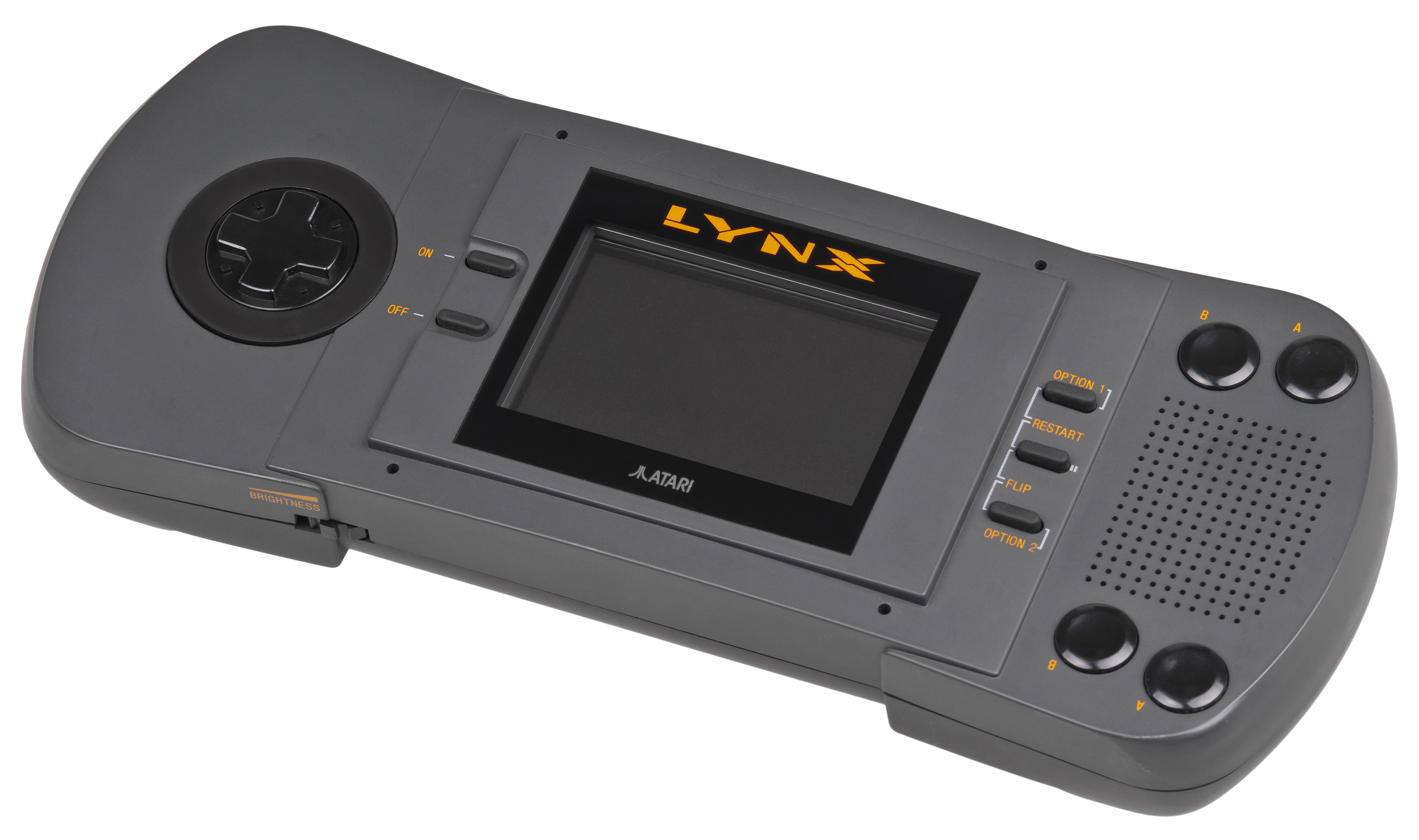
The interesting thing was, as the technology to make a powerful, handheld gaming system came into being, Nintendo wasn't the only company to be developing such a concept.  Epyx, a software company fresh off a handful of successful titles, began developing their own handheld gaming device in 1986, nearly a year before Game Boy designer Gunpei Yokoi began work on his handheld system.  Epyx didn't have the financial capabilities to mass produce their "Portable Computer Entertainment System", however, so Atari Corp. stepped in to help them make it a reality.  If only the Atari Lynx had debuted 6 months ahead of the Nintendo Game Boy, instead of the other way around, the gaming landscape might be somewhat different than it is today.  Would the Lynx have sold enough at its initial $179.99 price point to keep Nintendo from totally dominating the handheld gaming market?  Probably not, but the Game Boy might have been a bit less ubiquitous, and the poor Lynx might have become more than just the forgotten competitor from the worn out Atari.


The initial model of the Atari Lynx was quite large, and not nearly as portable as Nintendo's
Game Boy system, despite the latter still being a large, white plastic brick on its own.

While Tetris was a large part of the success of the Game Boy, due to its near-universal appeal, the fact that Nintendo marketed the Game Boy so well is another factor that contributed to its runaway success.  Unlike the Nintendo of the last decade or so, Nintendo in the late 1980's was dominating the market, but that didn't stop them from advertising their new product to anyone and everyone.  It was marketed as a fun system with a lot of games for kids.  It was marketed as "edgy" and "cool" to the teenage set.  It was also marketed toward adults, as a diversion from the doldrums of daily life.  Nintendo reaped the reward for all their efforts, as history has shown us, because the Game Boy line sold in the tens of millions within its first few years.


Nintendo successfully fused then-modern music and fast image cuts
with game footage to produce this kid-centric commercial.

Look at this hip 1989 teenage boy with his cool denim jacket, his, "I'm
ready for 1990" haircut, and his hot sneakers! Nerds like me, when I
was in school, would have looked up to him and his Game Boy.

I'd never seen this particular Game Boy TV spot before, but it truly
demonstrates the scope of Nintendo's advertising plan for the Game
Boy handheld. Serious, hard-working adults were just as much a
target as children, and many bought into the hype.

This is the adult-focused Game Boy commercial I remember seeing
as a kid, often watching prime time TV with my parents. Of course,
they weren't interested in such things, but many adults caught the fever.

Nintendo continues to dominate the dedicated handheld gaming market today, though the ubiquitous nature of smart phones has begun to eat into the overall market share.  Still, the fact that we're even playing games on our phones is itself a tribute to what Nintendo accomplished by putting real video games into our hands, not just LCD screens with static images and little interactivity.  The Game Boy was the first system to market that gave the consumer a true video game experience on the go, and it was affordable to do so.  They also wisely chose to include the ability to connect two Game Boy systems together via the Link Cable accessory, which came with the initial hardware, and worked with the system's pack-in game, as well as 2 of the other 5 US launch titles.  I spent many hours as a kid linking up with friends for head-to-head Tetris and Dr. Mario sessions, and after buying F-1 Race, I even got to play that against a friend or two.  It was the first time handheld gaming could be truly competitive as well, a feature that may well have been part of the inspiration for much of the online gaming boon many years later.

Another interesting thing about the Game Boy is that, despite the handheld lasting for nearly 10 years on the market (from its debut in April 1989 to the debut of the Game Boy Color in November 1998), there are only just over 500 original titles for the system.  Several games received "Million Seller" re-issues, and some games were later reissued by other publishers (such as Sunsoft re-issuing the Final Fantasy Legend games), but the total number of original, licensed games released in North America was just a shade over 500.  It seems odd that the Game Boy had so few games compared to the NES, which had somewhere in the 700+ range.  Having said that, the Game Boy did have basically twice the size of library as its closest competitor, Sega's Game Gear, and it dwarfed the library of the Atari Lynx, which topped out around 50 titles.  Despite all this, there are a number of Game Boy games that went on to spawn game series that have had lasting effects over the years.  From the sleeper hit Gargoyle's Quest (that produced 2 console sequels) to Kirby's Dream Land, which continues today in new and interesting iterations, and of course, the pervasive Pokémon series, which sold nearly 10 million copies in the United States alone, and as history has shown, became a worldwide phenomenon, right at the end of the Game Boy's life, all thanks to some innovative gameplay mechanics and the monster collection theme.  For a system 1 month away from the end of its life to have a game that became one of the system's best selling stand-alone titles is no easy feat.

This iconic clip is from the 1990's TV series, Picket Fences. I wasn't
allowed to watch the show, perhaps for obvious reasons, since the
themes of the show were a bit more mature in nature, but the sheer
mainstream saturation of the Game Boy was present in this show,
which was targeted more at adults and teens than kids.

It's easy to look back 25+ years and say that the Game Boy was a resounding success.  By contrast, I understand why some say that Nintendo is floundering with the Wii U, and to a lesser extent, their 3DS line-up of handheld systems, despite that continuing to be a money maker.  Even so, the market is a much different place now than it was during the time of the Game Boy, and there's far more competition for the same gaming space these days.  Smartphones have taken over where Nintendo's white brick once ruled, and even the 3DS (and Sony's poor Vita) struggles to continue to find an audience, amid free-to-play tower defense and puzzle games.  Still, all the hipsters, millennials, and soccer moms crushing candy and slashing fruit like a ninja owe the lion's share of that ubiquity to Nintendo, and their little handheld game system that could.  Without the Game Boy to begin that portable gaming revolution, you probably wouldn't be reading this article, because the lasting legacy of the Game Boy would have been far less important than it actually is.  For that, we all owe Nintendo a debt of gratitude.  I know my life would be less interesting without having spent a lot of time with my Game Boy as a kid, and even in more recent years as I've rekindled a love for the hobby.

Saturday, April 9, 2016

4-in-1 FunPak (1992)

Box art shamelessly stolen from GameFAQs. I don't think this box
leaves any room for interpretation as to what kind of game this is.

If it's not obvious by now, I love games.  Not just video games, but board games and card games as well.  I grew up playing a lot of card and board games with my family, so even though I don't get to play them as much today, I still enjoy them.  Certain games stick with you, even if it has been years since you've played them.  I can sit down and play certain games any time, and it doesn't take long to get back into the groove.  However, some of the board games I grew up with are much harder to go back to, because I was never very good at them.  Such is the case with much of this collection.

If the front cover art wasn't convincing enough, the title screen tells
you quite specifically what games you'll be playing on this cart.

To be fair, I never much played Chess, Checkers, or Reversi competitively.  As for Backgammon, I never played it as a kid.  I was always kind of fascinated with the idea of Backgammon, but it looked too complicated.  I also don't recall any of my friends who played it.  My parents had a game table that had a game called Carrom, and it had space for Backgammon, checkers, and other games, but we never played it.  Regardless, I haven't played the other 3 games in years, and it shows.

I really like this feature of this cart, that you can play 2 players without
needing a 2nd Game Boy. It was very nice of Beam Software to do so.

The 4-in-1 Fun Pak consists of portable video game versions of Chess, Checkers, Backgammon, and Reversi.  There are 1-player versions of each game, and 2 modes for 2 different players.  The first mode allows 2 players to use the same Game Boy, and just pass it back and forth.  The second is for players who have 2 Game Boys, and 2 copies of the game, like most "Game Link" supported carts.  Even without having played the game yet, I was pleasantly surprised with the inclusion of the first 2-player mode, as it's not often that a game maker can, or is willing, to include such a thing.  Kudos to Beam Software and Interplay for including this feature, as I'm sure it helped keep the peace amidst a few long car rides back in its day.

This screen makes Checkers look A LOT more exciting than it really is.

I'm not going to go into the rules of each game, as they're all pretty common games that most anyone who has ever played a board game should at least be familiar with in name, if not having played at least one of them.  Checkers is pretty widely known, and though Reversi may not be as common, but it's also known as "Go" (with slightly different rules, I believe), and was marketed in the US as Othello by Mattel.  Backgammon is pretty much the same game all over, though depending on the layout of the board, can play slightly different, from what I understand.  And of course there's the age old game of Chess, here using one of the oldest chess software engines out there, known as "Sargon".  It was written as early as 1977/1978, and was apparently used in a handful of famous chess matches against other chess engines, and against real chess champions to test the engine's algorithms.

One assumes the name "Sargon" is a reference to the Akkadian king.

With games of this type, it's almost guaranteed that the graphics are going to be extremely basic, and totally utilitarian.  If you were thinking that would be the case, you would be right.  The checkerboard for Checkers and Chess looks like you would expect - black and white alternating spaces (or light green and dark green, if you're playing on the original DMG model), and the game pieces look as good (or not) as you would expect them to.  The pieces in Reversi and Backgammon are as basic as they come, but they serve their function just fine.  There's very little animation going on, so for playing on the original hardware, this is actually a prime game to play without having to worry about screen blur.  Aside from that, there's very little here to attract you to the game, but then, if you're playing board games on a tiny 160x144 pixel screen, you're hopefully not going to expect anything too fancy.

I was playing randomly here just to grab screenshots. One more move
and I suffered a checkmate. That happened within 5 moves.

Sound is a mixed bag.  The sounds that play when you select and move pieces are pretty basic beeps, which aren't too obtrusive and sound fine.  The sound that plays when you make a mistake is super annoying - it's that kind of minor chord, mid-tone sound that you'd expect from the Atari 2600 or similar early 8-bit console.  What's worse, it plays constantly until you either press the A or B button, or press a direction on the D-pad.  If you've selected music to play, it plays over top of that as well, creating a terrible cacophony until you press a button to stop the grating sound from playing.  Speaking of music, there are 2 themes you can choose from by pressing the Select button during play, choosing the "MUSIC" option, and choosing which of the 2 themes you want to listen to.  Both are perfectly pleasant, and while they may get annoying after 15 or 20 minutes, they're nice little tunes that fit the slow, methodical pace of these board games.

Did I mention that the "Invalid Move" sound is really annoying?

In terms of options, each game seems to have a number of them.  Checkers, Reversi, and Backgammon each have 3 difficulties.  Chess, on the other hand, has 6 in total.  In Checkers and Reversi, there's a "Take Back" feature, which is sort of like an "undo" option.  You can roll back moves as many times as you like, in order to get a better sense of the progression of the game, and fix your mistakes.  This might seem like cheating, and in all reality it is, but used sparingly, it can give you a bit of cause and effect to help you learn the game strategies more effectively.  The "Reset" option allows you to exit the game you're playing and go back to choose another, which is a nice touch.  Backgammon includes the "Double" option (part of the rules of the game), as well as an "Auto Roll" feature, presumably to speed up the progress.  All games include a "Swap Sides" feature as well, and this is definitely something that could be exploited to cheat and "win" the game without having to put forth the effort.  I'm not sure what the purpose of that is, and since I don't have the manual, nor can I find a scan online, I honestly don't know what Beam Software was thinking by including that.

When your piece gets knocked back to the starting quadrant in
Backgammon when your opponent is near to having all their
pieces at their "home quadrant", you're almost assured to have
a quick defeat. I wasn't far from that scenario here.

I mentioned it before, but it bears repeating - I really appreciate the inclusion of a "single Game Boy" feature.  If you were a "typical American family" during the late 1980's or early 1990's, you probably went on a number of road trips to see family, see the sites, or just get out and drive.  In order to keep the peace, before the advent of such niceties as built-in DVD players, and to prevent you from having to play the same children's song cassette 30 times, you might have bought your kids a Game Boy.  If you were wealthy, you might have bought more than one, but the average middle-income family probably only owned one, unless one of the kids saved up a bunch of allowance or lawn mowing money to earn one.  With potentially only one Game Boy game in the car for a multi-hour jaunt across country, this is the type of game that would have made the trip more fun, and because of the slow pace, and the fact that each of these games can be drawn out, depending on the amount of time each player takes to move, a couple kids could easily burn 20 or 30 minutes on a single game of Checkers, and more on a game of Chess.  Similarly, a rousing Reversi match might be a good 15 minutes, and Backgammon would vary, though you could easily get anywhere from 10-30 minutes from a match.  The original Game Boy's blur-prone screen would have had no issues with this, and as long as you were driving in good sunlight, I can see how this would have been a good choice for kids who appreciated these kinds of games off-screen.

I'm getting absolutely walloped here. As you can see, the game's
AI has doubled my score, and is well on its way to trouncing me.

Incidentally, because I had never played Backgammon before, and didn't know the rules, I tried several times to play before I broke down and looked it up.  I tried to read through a rules website, but quickly became bored with the dry explanation.  I then went to YouTube and searched "How to play Backgammon for beginners", and was greeted by an entire series of short videos by a heavy-accent bearing man from what I can only assume is the UK.  I spent over half an hour watching these intro videos, and though I still fumbled with the game after that, I was actually beginning to figure things out.  I downloaded a Backgammon app on my iPhone after that, and having played a few matches on that, I went back and finally got the swing of this version, after figuring out which direction I was supposed to go with my pieces.  I had missed that salient point early on, and it was throwing me off.  For the Backgammon beginner, I would recommend looking up tutorials, because it took me a long time to figure out how to actually play.  Once I did, I began to actually employ some strategy, and have even been able to win once or twice.  Given the chance now, I think I could play Backgammon in real life and enjoy myself, so I owe it to this cart for formally introducing me to it, despite the challenges in getting it figured out.

The Chess game has a neat board editor where you can, presumably,
build out your own board. Unfortunately, you can't use more than the
normal requisite number of pieces on each side so you don't break
the Sargon engine's ability to calculate moves. Bummer.

So what's the verdict here?  That will depend largely on your affinity for these board games.  I'm terrible at Checkers currently, because I haven't played in years.  My dad tried, and failed, to teach me to be strategic in Chess, and my childhood best friend didn't fare much better, so I never really learned to play it well.  I've always been pretty bad at Reversi, having been regularly stomped on in school when playing it as Othello.  Backgammon, however, is intriguing to me because I never played it as a kid, and it seems like the combination of strategy and luck makes it stand out more for me than the other games.  I can't say I would spend much time with it, but had I owned this as a kid, my younger brother and I would likely have spent a fair bit of time with it in the car, seeing as how I owned the Game Boy, and he was often left to just watch me and sulk because he didn't.  There are fancier versions of each of these games available for modern smartphones these days, so unless you're looking to conserve your phone battery so your kid doesn't run it down playing these games, it's a good, relatively inexpensive alternative.  Still, it's hard to recommend nearly 25 years after its release, if only because most anything you can get today, for free even, would look, sound, and play vastly superior to this iteration.  Still, for a few bucks, it's a decent enough time waster.  I'll give it a casual recommendation, if you can find it cheap.  I probably paid more than it was worth, at either $7 or $8, as I wouldn't pay much more than half that, unless you're a masochistic collector like I am.

Thursday, February 25, 2016

Asteroids (1991)

Image shamelessly stolen from GameFaqs.
As with many Atari 2600 games during the console's heyday, sadly,
this Asteroids artwork looks way cooler than the actual gameplay. Also,
is it just me, or does that ship look suspiciously like a Hoth snowspeeder?

The name Atari doesn't have a lot of currency today, but between 1977, after the launch of Atari's Video Computer System (aka the Atari 2600), and it's downfall in 1983, the Atari name had a lot of clout and recognition in the entertainment industry.  This is due, in part, to Atari's home video game console and its dominance of the home video game market, but a large part of their fame was the popularity, and ubiquity, of Atari's arcade games.  By now, most everyone knows that Atari's Pong was a sensation in 1972, and in the years that followed, they scored several hits with other titles like Night Driver, Breakout, Lunar Lander, Tempest, Centipede, and of course, Asteroids.  Were it not for the glut of bad console games and consumer burnout in late 1982 and early 1983, Atari would likely have been held in much higher regard than they have been in recent years.  Alas, twas not to be.

I wish I would have had an opportunity to play the Team Play and
Competition Play modes, because that would certainly extend the
life of an aging arcade game like this, far more than single player.

But for a short time, Atari were a dominant force in the arcade scene, as well as the home console market, and many of their early games are venerable classics.  Asteroids, released in 1979, was a vector graphics-based game, which means that, instead of what we normally think of with 2-dimensional video game graphics, with flat images full of color from border to border (raster graphics), these graphics were often simple, single-color affairs that consisted of wire-frame images that were merely outlines.  This made them look quite simple, but the reduced aesthetic allowed for the hardware to focus more on the speed and animation of the simple wire-frame images, so as to provide faster action, as well as smooth scrolling and motion.  Later Atari vector graphics titles, like Tempest and Space Duel, incorporated more color, and more sophisticated gameplay, but at the time of its release, Asteroids was a revolutionary experience, and resulted in it becoming Atari's best selling arcade game of all time.

Why your spaceship is thrown into the middle of a random asteroid
field is never explained. I demand answers! I demand justice!

The gameplay of Asteroids is deceptively simple.  You control a small space craft in the middle of an asteroid field, and your job is to destroy the asteroids and stay alive.  This is easier said than done, of course.  Each time you successfully fire upon one of the large space rocks, it breaks down into 2 smaller boulders, each of which will break down again into their own set of 2 smaller hunks of rock.  The game takes place on a single screen, so when the asteroids go off screen, they simply loop back to the opposite side, in a position relative to the one they exited, and continue to travel in the same direction.  Add to that, the alien ships that sometimes brave the asteroid field to try and take out your craft, and you have multiple objects on screen hurtling toward you to cause your imminent doom.

Your options are to turn your ship left or right, fire your cannon, use your thrusters to move forward in the direction your craft is facing.  Unlike the full vacuum of space, however, there is some gravity, which means using the thrusters doesn't mean you'll continue to move in that direction perpetually.  Learning how to manipulate the thrust feature becomes an essential strategy for dodging oncoming debris, as well as maneuvering your ship to better snipe the UFOs and take out the space rocks.  Finally, you have a "warp" button you can use to jump to a random spot on the play field.  The warp feature is handy as well, though it's best to use that as a last resort, as you can just as easily warp away from one certain death scenario right into another, as the warp feature is unpredictable.

Every time you score 10,000 points, you get an extra ship. To
paraphrase Han Solo: "You're gonna need 'em."

With the Game Boy version of Asteroids, the graphics are given the raster treatment, rather than trying to emulate the vector look of the original.  This was a wise move by Accolade, who ported the game, as the original Game Boy hardware might have had a difficult time replicating the smooth scrolling of the arcade hit.  Instead, we get a small, but well rendered ship, nice looking round asteroids with craters and a sense of depth, and a rather obvious flying saucer-style enemy vessel, that gives the game a classic science fiction feel, and is a nod to the source material.  It's all very utilitarian and sparse, but for what it is, it works.  For this kind of game, it's better to keep things simple and uncluttered, and that's just what took place.  The twinkling stars in the background are a nice touch.

Sound design in the game is also very minimalist in nature.  There's a bit of an intro song that plays when the title screen appears, and a little ditty that plays when you lose your last life and get a Game Over screen, but otherwise, it's just basic sounds.  Your ship's fire, the sound of asteroids breaking up, your own ship exploding, and the annoying, high-pitched sounds made when an enemy vessel is flying across the screen are just about the only sound effects in the game, outside of the original game's iconic "heartbeat" thumping that gets progressively faster throughout the level as you take out more asteroids and enemy ships.  It doesn't tax the Game Boy hardware, but it sounds good enough, and does its best to try and replicate the sound design found in the original arcade cabinet.  It gets the job done, and nothing more.

Enemy ships are not immune to the asteroids, as luck would have it.
This UFO is about to meet my friend, "Rocky".

Control is easy, as there are very few options.  You can point the ship by pressing Left or Right on the D-pad, and press Up on the D-pad to use the thrusters to move forward in the direction you're facing.  Hold Up on the D-pad, and your ship progressively gets faster up to a point, so be careful not to hold Up too long, or you'll go careening into one of the many space rocks.  The B button fires your cannon, which is your one and only weapon against the asteroids and enemy spacecraft, and the A button is a "warp" feature, which will send your ship to a random spot in the screen.  There's a definite risk/reward factor to the warp, because you can use it to get out of a sticky situation, but because there's no telling where you'll end up, you could be warping directly to your death.  The Start button pauses the game, and the Select button, as one might expect, does nothing at all.

Because there's no real end to Asteroids, and the game continues to go level after level and just get faster and more frenetic, the whole point of the game is two-fold: survival, and score.  The longer you can stay alive and continue to shoot down the titular asteroids, as well as enemy vessels, the more points you'll score.  For each 10,000 points you amass in this version, you receive an extra life.  The scoring is the same in this version as it is in the arcade original, as near as I can tell.  That means that large asteroids give you 20 points, medium sized rocks are 50 points, and the little pebbles net you 100 points.  The flying saucer enemies give you 200 points, and the tiny ships give you a generous 1,000 points.

Under the right conditions, you'll start seeing smaller, faster enemies
that shoot more accurately and relentlessly at you.  What did I ever
do to them to deserve this kind of maltreatment?

Obviously, shooting down the enemies is where you can earn the most points, but since they don't show up as frequently as the asteroids are plentiful, there's a balance to scoring big points.  One classic strategy is to destroy all but one tiny asteroid, and let it fly around on the screen while you easily dodge it, and pick off enemy ships as they continue to come on screen periodically.  For example, you can score approximately 2,000 points in the first stage by destroying all the asteroids, shooting down a pair of ships, and then maybe picking off a third before you destroy the last rock.  At 200 points per larger flying saucer, if you're patient enough, and skilled enough to avoid both the last asteroid as well as the enemy fire, you can quickly rack up a pretty good score.  Another notable strategy, or perhaps design choice, is that when you fire your cannons, the bullets only reach so far, so you can't just fire away and destroy everything within a few seconds.  However, if you're close to one edge of the screen or another, firing your cannons means those bullets will loop around to the opposite side of the screen, so you can use that to your advantage to destroy rocks as they fly onto the screen from that side.  As you progress, the asteroids begin to fly faster, and there are more of them, so each level gets progressively more difficult and frenetic.  If you want to master Asteroids, the name of the game (literally and figuratively) is practice, and lots of it.

Despite the fact that Asteroids was released in the arcades in 1979, and this conversion was released 12 years later, the ability to truly capture the arcade experience at home hadn't truly been realized yet, and that's especially true of the Game Boy.  This port gives a pretty good approximation of the arcade game, though using raster graphics instead of the original vector approach, despite a few notable differences.  The arcade game can relatively fast paced and frenetic, and because of the vector graphics and low hardware requirements, the movement of your ship and other objects on screen is fast and fluid, and you can pull off some really tricky maneuvers with your craft.  This fluidity doesn't exactly translate to the Game Boy, because the speed of the game can't compare with the original, and with the original DMG model's blurriness happening with any kind of quick motion, it would make the game nigh impossible to truly enjoy if it tried to replicate the speed of the arcade original.  As such, the game feels like the laid back big brother of the original.  He's a bit more stylish, with his 4-shades of green and raster graphics, and slightly more fleshed out aesthetic, but moves slower and isn't in as big a hurry to get somewhere as little brother in the arcade.  On the plus side, the game replicates the "heartbeat" effect, that sort of Jaws-esque harbinger that grows faster and more menacing as more Asteroids are destroyed and more particles fly around on screen, so it really gets that unique element right.  Also, I found the collision detection to be nearly pixel-perfect, so if you get hit by an asteroid flying at you, don't get mad - it was probably your fault.  One odd quirk I found is that, when entering your name on the high score screen, sometimes trying to change the letter using up and down, or choosing a letter with A, or erasing one with B, is less than responsive.  I suspect that may be because of the way the letters are flashing on the screen, and the fact that, perhaps the Game Boy is being taxed a bit, and the commands you're inputting don't always register.  It's a minor issue, but noticeable enough to mention.

If you're a little too happy with the bullets, you'll find yourself totally
overwhelmed by asteroids from all sides. Prepare to die.

At the end of the day, it's somewhat difficult to recommend this port of the game.  Not because it's not functionally a good game, because it is.  It's hard to recommend because, just 4 short years after this cart's release, the game came out again as Arcade Classic No. 1, and that cart contained this conversion of Asteroids, as well as a conversion of the classic Missile Command.  That cart has Super Game Boy compatibility, but also gives a couple notable upgrades to this port of the game: that is, it includes an option to change the button configuration, if you find the default control scheme not to your liking, but more importantly, you can choose to play in the original vector style, though still with the twinkling raster-based stars in the background.  The advantage of this version is both of the 2-player options, so if that's the experience you're looking for, then obviously this 1991 version will be the one to seek out.  For anyone just looking for the single-player experience, the latter release with another game on the cart, including the option for the original vector graphics, would seem to be the no-brainer option.  Either way, you're getting a reasonable facsimile of the original game, but without the ability to have the really fast action that makes the original still attractive to play.  That said, you can do a lot worse for $4 or $5 on the Game Boy, so I'd say if you have any interest in classic arcade games on the go, or Asteroids in general, this might be one to add to your collection.  Tentatively recommended.